On October 28, 2026, the Bank of Canada raised its key rate by 0.25 points to 2.50%. It’s the first hike since 2023. Prime goes from 4.45% to 4.70%, so variable-rate payments go up right away: about $110 a month on an $800,000 mortgage. For where rates may go from here, see our Canada interest rate forecast.
But the hike itself isn’t the big news. Markets expected it, maybe by December. Fixed rates had already climbed from about 4% this summer to about 4.6%. The real question is how high rates go and how fast, because that sets your payments for the next five years.
Here’s why the Bank moved, how far rates could rise, how much Toronto prices may need to adjust, and what multiplex investors should do now.
Why Did the Bank of Canada Raise Rates Now?
September inflation came in at 3.1%, mostly because of gas prices. Without gas, it was 2.2%, and the Bank’s two core measures were 1.8% and 1.9%. So today’s inflation isn’t the problem. The Bank is reacting to where inflation could be heading.
In its latest Business Outlook Survey, about half of businesses said they plan to pass higher costs from the Iran war and tariffs on to customers. At the IMF meetings, Governor Tiff Macklem said higher energy prices were helping growth but raising the risk of inflation. Market odds of a hike jumped to 76%, and many top economists changed their forecasts.
Two more things pushed the Bank: the US Federal Reserve raised rates in September, and Macklem was criticized for moving too slowly in 2022. He doesn’t want to fall behind again.
Fixed Mortgage Rates Already Priced In Most of This Hike
Fixed rates follow the 5-year bond yield, not the Bank’s rate, and bond yields moved weeks before the decision. Variable rates follow prime, so variable borrowers feel the hike right away.
| $800,000 Mortgage | This Summer | Now |
|---|---|---|
| Best 5-year fixed | ~4.0% / $3,800 | ~4.6% / $4,080 |
| Best variable | ~3.5% / $3,580 | ~3.75% / $3,690 |
Monthly payments on a 30-year amortization. For educational purposes only.
That’s about 7% more a month for a new fixed-rate borrower. The timing of this hike matters less than where rates peak and when, because that’s what sets your payment for five years.
What Happened to Toronto Prices the Last Time Rates Went Up?
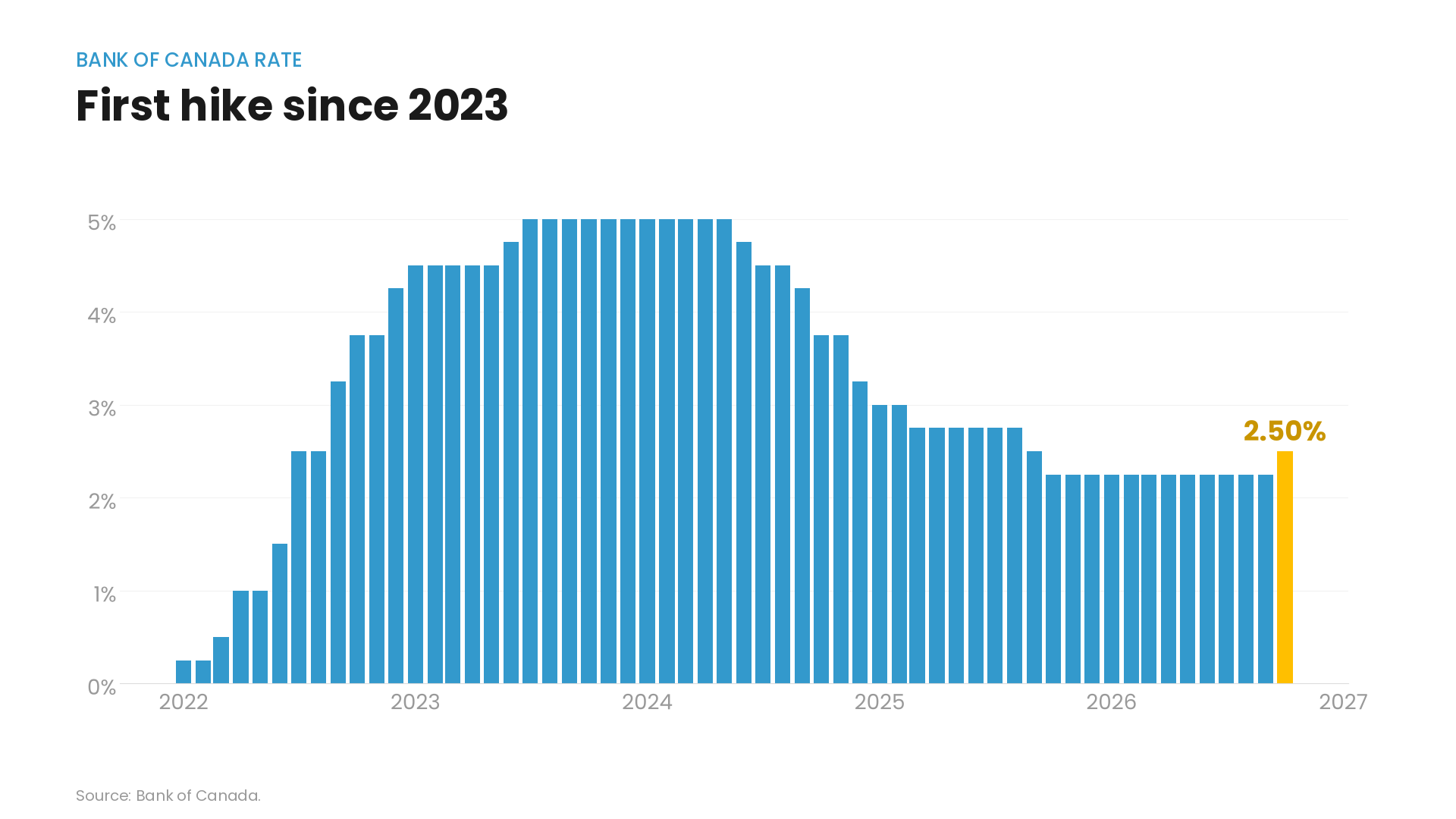
In 2022, fixed rates jumped from about 2% to a peak of 5.5%. Toronto’s average price fell from $1,334,045 in February 2022 to $1,006,409 in September 2026, about 25% lower.
| Feb 2022 Price Peak | Sept 2026 | Sept 2026 in 2022 Dollars | |
|---|---|---|---|
| Average price | $1,334,045 | $1,006,409 (–25%) | $869,064 (–35%) |
| Fixed rate | 2% | 4.6% | 4.6% |
| Monthly payment (20% down) | $3,940 | $4,107 | $3,546 |
For educational purposes only.
Prices of everything else rose about 16% over that time. So after inflation, Toronto prices are down closer to 35%, which is roughly what the jump in rates alone would predict. And prices didn’t bounce back when rates came down.
Now rates are rising again, so prices could slip further. But we don’t expect anything like 2022. Markets expect the Bank’s rate to reach about 3.25% by September 2027, roughly 0.75 points above today. For the latest numbers, see our Toronto market updates.
How High Will Rates Go, and How Much Could Toronto Prices Fall?
All five big banks expect higher rates by the end of 2027, but they don’t agree on how high.
| TD, CIBC and BMO | 2.75% |
| RBC and Scotiabank | 3.25% |
That wide range tells you how uncertain this is. If oil drops after the US midterms, or trade tensions get worse, the hikes could end quickly. Some economists warn that raising rates during an oil shock could make a recession the bigger risk in 2027, which would push rates back down.
Here’s what today’s rates mean for prices. Take a $1M house with 20% down: an $800,000 mortgage on a 30-year amortization.
| Payment at 4% (this summer) | ~$3,800 |
| Payment at 4.6% (now) | ~$4,080 |
| Price for the same payment as this summer | ~$932,000 (–7%) |
For educational purposes only.
In other words, to keep buyers’ payments the same, prices would need to drop about 7%. Want to see how a higher rate changes a deal you’re looking at? Try our investment calculator.
What Toronto Multiplex Investors Should Do Now
If You Have a Variable Rate
Call your lender this week. Find out if your payment stays the same (with less going to principal) or goes up right away.
If You’re Getting a New Mortgage
Variable is around 3.75% and fixed around 4.6%. If markets are right, variable will climb toward today’s fixed rate, but you’d get months at a lower rate first. Variable also gives you flexibility: you can usually switch to fixed any time, and breaking it often costs less, which helps if you plan to refinance for a project. The downside is more risk. Variable borrowers took the bigger hit last time.
If You’re Buying
Offer lower. You don’t need to wait for the market to drop another 7%. Sellers are more open to negotiating than they’ve been in years. Right now we’re buying turnkey multiplexes for clients around $900,000 and negotiating 10 to 15% off in some cases.
Here’s a real triplex we’re working on:
| Turnkey Triplex | At Asking | 11% Off |
|---|---|---|
| Purchase price | $900,000 | $800,000 |
| Total cash in (20% down, closing, $50K reno) | $260,450 | $236,450 |
| Rent (3 units) | $7,300 | $7,300 |
| Utilities, tax and insurance | –$1,152 | –$1,152 |
| Mortgage at 4.5% | –$3,630 | –$3,227 |
| Month 1 cash flow | +$2,518 | +$2,921 |
Before maintenance and vacancy. For educational purposes only. Actual figures and returns may vary.
Negotiating 11% off saves $24,000 in cash up front and adds about $400 a month in cash flow, for as long as you own it.
See what’s on the market right now in this week’s Deal of the Week.
Negotiate to Your Number Before Rates Climb
This first hike matters less than where rates go from here. And in a slower market, you don’t have to wait for prices to fall. Deals that still work at higher rates have less competition and more room to negotiate. We’ll stress-test any deal at higher rates, show you what discounts we’re getting right now, and tell you straight when we’d pass.
Our brokerage specializes in Toronto multiplexes. We’ll help you find deals, crunch the numbers, and guide you through renovations and management. If you want full support in Toronto multiplex investing, our team can help you:- Find high-potential properties
- Crunch the numbers so you know exactly where you stand
- Coach you through renovations to maximize returns
- Lock in great tenants
- Provide full property management so your investment runs smoothly
What do Toronto multiplexes really cost and earn?
We pulled the numbers from the 50+ deals we worked on in the past year: build costs, rents by unit type, and how the refinances came out. Free, and no best case.
