Thinking about buying an investment property in Toronto? Don’t guess. Run the numbers first.
This free Toronto multiplex investment calculator is built for investors buying duplexes, triplexes, and small multiplexes. It models cash flow, cap rate, total ROI, BRRRR refinance outcomes, and your true all-in costs including Toronto and Ontario land transfer tax.
If your deal only works with perfect rents and zero surprises, it doesn’t work. This tool helps you pressure-test the math before you waste time on the wrong property.
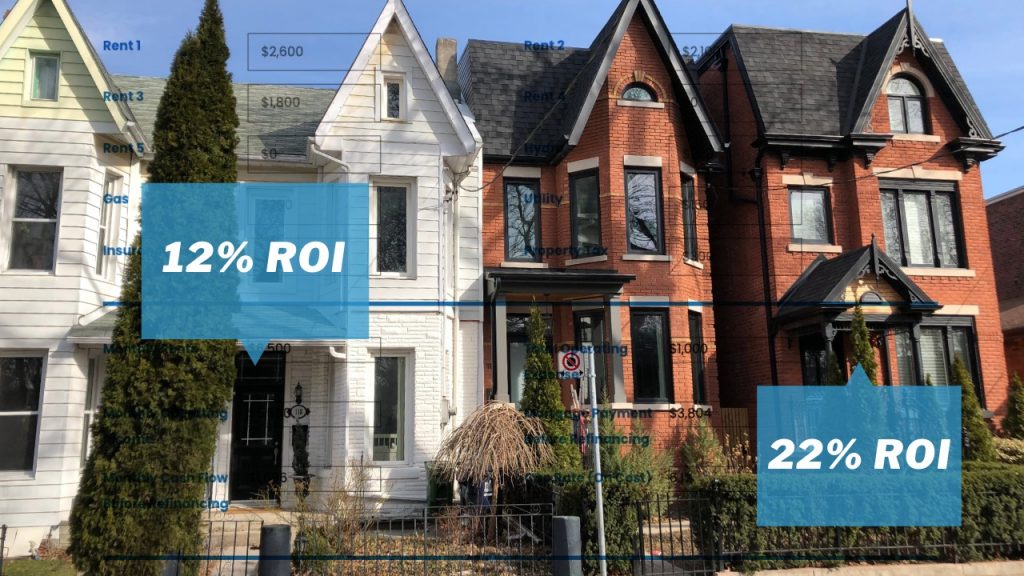
True upfront costs:
Down payment, renovations, Toronto and Ontario land transfer tax, closing costs
Monthly performance:
Gross rental income, operating expenses, mortgage payments, monthly cash flow
Return drivers:
Cash flow, equity gain via mortgage paydown, renovation value-add, and market appreciation
Investor metrics:
Cap rate, annualized ROI, and total return so you can compare this deal against any other investment
Refinance outcomes:
Completion value, how much you can pull out and what the property still earns after
Whether you’re underwriting a Toronto duplex, triplex, fourplex, or a full BRRRR conversion, this free multiplex investment calculator gives you the complete picture — in real time.
Real Estate ROI Calculator: Input Your Numbers
Input Your Numbers to See Cash Flow, ROI, and Total Returns
For educational purposes only. Based on 4% mortgage rate, 30-year amortization, 2% annual market appreciation. Actual returns will vary.
Actual returns may vary depending on assumptions. Read our definitions and assumptions.
What the Numbers Look Like on a Real Toronto Multiplex Deal
Not sure what to input? Here are two real scenarios that show how Toronto multiplex investors use this calculator — a turnkey triplex and a value-add conversion.
Example: Turnkey 3-Unit Multiplex In Toronto
The property: A stabilized three-unit house, purchase price $1,000,000. Three tenanted units, no renovation needed. You’re buying cash flow on day one.
What you put in: Total capital to close: $234,450. That includes your 20% down payment and closing costs. No renovation budget needed.
What you get back monthly: Three units rent for $5,900 per month combined. After expenses and mortgage, you’re cash flowing around $1,000 per month.
Why this deal works: No renovation risk, no construction timeline, no surprises. You’re cash flow positive from the moment you close. The trade-off is lower upside — you’re paying a premium for a property someone else already stabilized. This is the right deal for an investor who wants to get started cleanly and build from there.
For educational purposes only. Market appreciation estimated at 2% annually on $1,000,000 purchase price. Actual returns will vary.
For educational purposes only. Market appreciation estimated at 2% annually on $900,000 purchase price. Value-add appreciation reflects renovation uplift. Actual returns will vary.
Example: Value-Add Toronto Triplex Conversion
The property: A three-unit conversion project, purchase price $900,000. You’re buying below market and creating value through renovation.
What you put in: Total capital to close and complete the renovation: $360,450. That includes your down payment, $150,000 renovation budget, and closing costs.
What you get back monthly: After stabilization, the three units rent for $7,300 per month combined. After expenses and mortgage, you’re cash flowing close to $3,000 per month.
The refinance: Once the renovation is done and the property is stabilized at $1,200,000, you refinance and pull $240,000 back out. Your net capital left in the deal drops to $120,450. The property still cash flows $1,735 per month after the new mortgage payment.
You’ve essentially recycled most of your capital to use on the next deal — while this one keeps paying you every month.
Why this deal works: Higher effort than the turnkey, but significantly better capital efficiency. This is how investors scale without tying up all their money in one property.
The bottom line: Both deals work. The right one depends on your capital, your timeline, and how much complexity you want to take on. Input your own numbers above and see where your deal lands.
If you want help reading your results or pressure-testing your assumptions, book a free call with our team. We’ll walk through the math with you.

Not Sure What Your Numbers Mean?
This is where most new investors get stuck. We’re here to help.
Download our free Toronto Real Estate Starter Guide, or
Book a free call with our team — we’ll walk through your results and show you what makes a smart, profitable investment based on your goals.
No pressure. Just investor-first advice.
Why Toronto Investors Choose Us
FAQ: Toronto ROI Calculator + Toronto Multiplex Investor FAQs
Q: What’s the difference between operating income and cash flow?
A: Operating income (NOI) is what the property makes before mortgage payments. Cash flow is what’s left after the mortgage. NOI tells you profitability. Cash flow tells you whether the property can carry itself. For a deeper breakdown of how NOI affects property value, read our Toronto cap rate guide.
Q: What’s the difference between cash flow and taxable income?
A: Cash flow is your monthly leftover cash. Taxable income depends on how income and expenses are treated for tax purposes. You can have tight cash flow and still build strong equity through mortgage paydown. Don’t confuse “building equity” with “this deal is safe.”
Q: What is cap rate and why does it matter in Toronto?
A: Cap rate is NOI divided by market value. In Toronto, cap rate heavily influences value, refinance potential, and downside risk. Low cap rate deals leave less margin for error.
Q: Does this calculator use “cap rate on cost” or “cap rate on value”?
A: It can show cap rate based on your all-in cost, but serious underwriting should consider stabilized market value. Using only “cap rate on cost” can make you feel good while overpaying.
Q: What is value-add appreciation?
A: Value-add appreciation is the value you create through renovations or added units. If you spend $80K and value increases by $120K, your value-add gain is $40K. If you’re planning to add units, review our guide on how to create a multiplex in Toronto.
Q: What is equity gain?
A: Equity gain is mortgage principal paydown. Every payment reduces the loan balance and increases your ownership. It builds wealth quietly, but monthly cash flow still matters.
Q: What is net return?
A: Net return combines cash flow, equity gain, value-add appreciation, and market appreciation, minus closing and selling costs. It shows your total performance, not just monthly income.
Q: What’s the difference between cash flow and ROI?
A: Cash flow is monthly leftover income. ROI includes cash flow plus mortgage paydown, renovation gains, and appreciation. ROI gives the full picture of your investment performance.
Q: Does this calculator include Toronto land transfer tax and closing costs?
A: Yes. It includes Toronto and Ontario land transfer tax plus estimated legal and closing costs so your “all-in” number reflects real Toronto conditions.
Q: Can I use this for duplexes, triplexes, and fourplexes?
A: Yes. It’s built for Toronto residential properties up to five rental units.
Q: What if I’m planning a sixplex in Toronto?
A: Zoning rules matter more than your spreadsheet. Before assuming anything works, read the full breakdown of Toronto sixplex regulations.
Q: Can I use this calculator for a conversion project?
A: Yes, but only if the additional units are legal and buildable. If you’re converting a house into multiple units, start with our guide on creating a multiplex in Toronto.
Q: Do garden suites improve ROI?
A: They can. Garden suites often produce strong incremental income, but build costs determine success. Before building, review our Toronto garden suite guide.
Q: Do laneway suites improve ROI?
A: Laneway suites can boost NOI and long-term value, but only if construction costs are controlled and rents are realistic. Learn more in our laneway suite guide.
Q: What is “Cash-Out on Refinancing”?
A: It’s how much money you can pull out after refinancing based on the new value minus what you still owe. Many BRRRR investors use this to scale into the next deal.
Q: How is “Monthly Cash Flow on Refinancing” different from before?
A: Refinancing usually increases your mortgage payment. You may pull cash out but reduce monthly cash flow. This number shows whether the property still carries itself.
Q: What does “Net Capital on Refinancing” mean?
A: It’s how much of your own money remains in the deal after refinancing. The lower this number, the higher your capital efficiency.
Q: Should I refinance right away or wait?
A: It depends on stabilization and lender requirements.
Q: What if I’m not sure what rent to input?
A: Use conservative rent estimates based on comparable properties. Optimistic rents are how investors buy bad deals.
Q: Is this tool free?
A: Yes. No sign-up required. Run your numbers anytime.
Ready to Turn Your ROI Into Reality?
Book a free strategy call and we’ll pressure-test your assumptions, walk through the refinance math, and help you avoid buying a deal that only looks good on paper.