Maybe you inherited money. Maybe you’re early in your career, self-employed, or paid in cash. Either way, you have a good chunk of cash, but your reported income is low. So the bank won’t give you a big mortgage.
A lot of investors in this spot come to us with the same plan. Go commercial. Buy a 5+ unit building, because the building’s rent helps you qualify, and cover the rest in cash. It sounds smart. But it takes a lot more cash than most people think.
Below, we walk through what a Toronto commercial building really takes, then put the same cash into a triplex conversion. We’ll show you why the triplex usually comes out ahead, even with a small mortgage.
How Commercial Lenders Decide What to Lend
Say you want a Toronto 5-plex with market rents in a decent area. Five two-bedroom units at about $2,375 a month each. That’s about $142,500 a year in rent. Take off about 30% for operating costs like taxes, insurance, utilities and repairs, and you have about $100,000 a year in net income.
Commercial lenders don’t just ask if the rents are high. They want the building’s net income to cover the mortgage payment with about 20% to spare. That’s called a debt coverage ratio of 1.2.
Then the price. Commercial buildings are priced off their rents using a cap rate. In Toronto, buildings like this are trading at about 4.5% to 5% right now.
| Rent (5 two-bedrooms x $2,375 x 12) | $142,500 |
| Operating costs (30%) | -$42,750 |
| Net income | $99,750 |
| Max mortgage payment ($99,750 ÷ 1.2) | $83,125/yr |
| Loan that payment supports (5%, 30 years) | $1.29M |
| Price at a 5% cap rate ($99,750 ÷ 5%) | $2M |
| Loan as % of price | 65% |
For educational purposes only. Actual figures and returns may vary.
So yes, the building qualifies instead of you. But it only qualifies for a loan of about 65% of the price. And at a 4.5% cap rate, the price goes up while the loan stays the same, so you’d need even more cash.
How Much Cash a Toronto Commercial Building Really Takes
On a $2 million building with a $1.29 million loan, you need about $705,000 down. Add about $75,000 in closing costs, mostly land transfer tax, and you’re at about $780,000 of your own cash.
Of course, there are cheaper commercial buildings in Toronto. But they’re cheaper for a reason. Usually the rents are below market. In Ontario, those tenants are rent controlled, so you could be sitting on low rents for years. That’s a risk on its own, and it might not be what you signed up for.
The best case for commercial is real, and it’s fair to give it a shot. You buy a fully tenanted building, qualify on the rents already in place, and get rent from day one. Here’s what the year one return looks like.
| Cash in ($705K down + $75K closing costs) | $780,000 |
| Cash flow (about $1,400/month) | $16,600 |
| Principal paydown | $19,000 |
| Appreciation (conservative 2% of $2M) | $40,000 |
| Total year one | $75,600 |
| Return on cash in | 9.7% |
For educational purposes only. Actual figures and returns may vary.
If you have the cash and want something hands-off, it works. But for most Toronto investors in this spot, the same cash works harder on the residential side.
The Triplex Option: Same Cash, Different Result
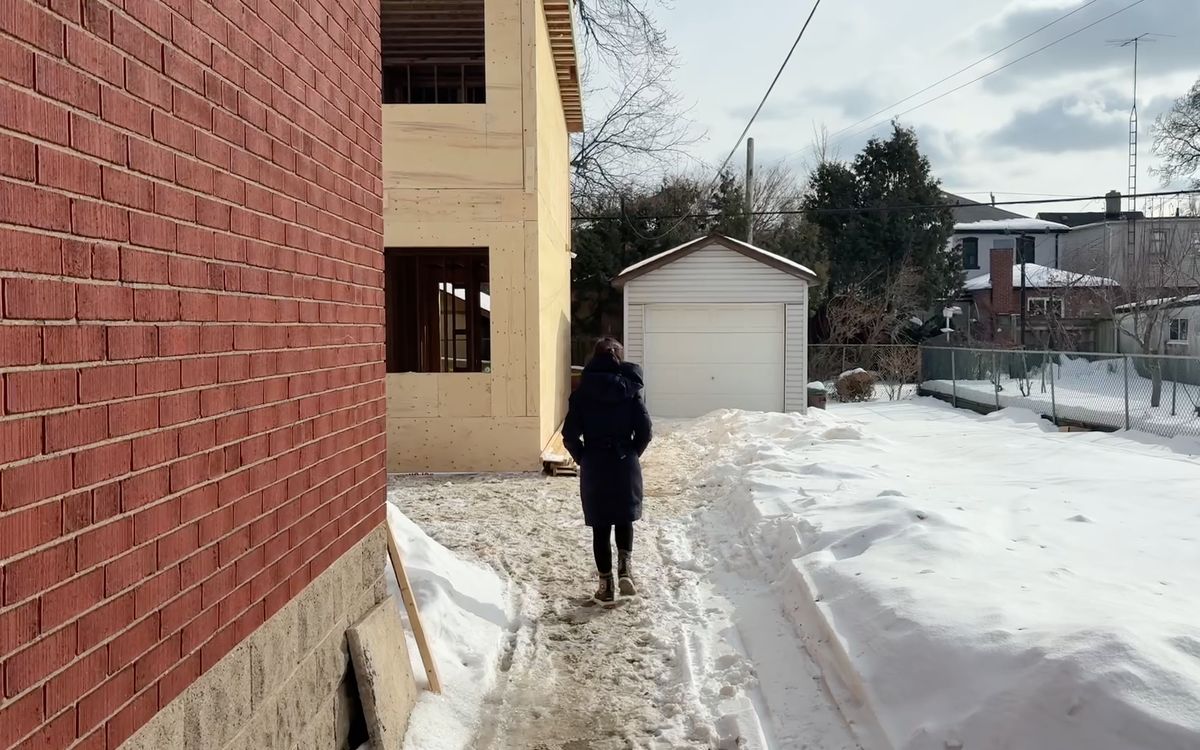
Now let’s put about the same cash into a real house we’re looking at right now in St. Clair West. It’s detached, vacant, needs a full renovation, and has a laneway out back. It can be bought for around $900,000.
Say your income, plus some of the rent the house can earn, only qualifies you for a $400,000 mortgage. That’s why so many people on starting salaries can’t afford Toronto. But if you already have a good chunk of cash and you’re thinking of going commercial, look at this option instead.
| Purchase price | $900,000 |
| Mortgage | $400,000 |
| Down payment | $500,000 |
| Closing costs | $30,000 |
| Renovation (paid in cash) | $250,000 |
| Cash in | $780,000 |
For educational purposes only. Actual figures and returns may vary.
That’s the same $780,000 you were thinking of putting into the commercial building. The renovation turns the house into a triplex. Based on market comparables, it should be worth about $1.4 million when it’s done.
| Unit 1 (2 bed) | $2,800 |
| Unit 2 (2 bed) | $2,300 |
| Unit 3 (basement) | $1,750 |
| Parking | $250 |
| Total rent | $7,100/month |
For educational purposes only. Actual figures and returns may vary.
Curious how these rents and costs compare to other projects? You can see what Toronto multiplexes really cost and earn.
How the Refinance Makes You a Stronger Borrower
On a property under 5 units, you still need to qualify with your own income. But the rent from the multiplex counts too. Many lenders count about 80% of the rent as income.
| At Purchase | At Refinance | |
|---|---|---|
| Salary | $80,000 | $80,000 |
| Rent counted (80% of $85,200) | – | $68,000 |
| Qualifying income | $80,000 | $148,000 |
| Mortgage | $400,000 | About $700,000 |
Your job didn’t change. The triplex made you a stronger borrower. Refinance to about $700,000 at a 4.5% residential rate over 30 years and pay off the $400,000 mortgage. About $300,000 comes back to you, and about $480,000 stays in the deal. You can run your own version with our mortgage calculator.
| Cash flow before refinance ($400K mortgage) | $3,600/month |
| Cash flow after refinance ($700K mortgage) | $2,100/month |
| Year one: cash flow + principal paydown + 2% appreciation | $64,700 |
| Return on $480K left in | 13.5% |
For educational purposes only. Cash flow is after about $1,435/month in taxes, insurance and utilities. Actual figures and returns may vary.
Here’s how the two compare side by side.
| Commercial 5-Plex | Triplex Conversion | |
|---|---|---|
| Cash in | $780,000 | $780,000 |
| Cash back | $0 | $300,000 |
| Net cash left in | $780,000 | $480,000 |
| Cash flow | About $1,400/month | About $2,100/month |
| Value created | $0 | About $220,000 |
| Year one return on net cash | 9.7% | 13.5% |
For educational purposes only. Commercial at 5%, residential at 4.5%, both over 30 years. Actual figures and returns may vary.
There’s also the exit. A Toronto triplex is easier to sell than a commercial building. Your buyers can be end users as well as investors, and at a lower price, a lot more people can afford it. That laneway out back could also take a laneway suite later to boost cash flow even more.
Higher Income, Less Cash: The 20% Down Option
$780,000 is a lot of money, and most people don’t have it. Most of the investors we work with are the opposite: less cash, but a stronger income. For them, the numbers look even better, because they can use more leverage.
Same house. Say your income qualifies you for a regular 20% down payment. You put $180,000 down, about $30,000 in closing costs, and $250,000 into the renovation. That’s about $460,000 in, instead of $780,000.
| $400K Mortgage | 20% Down + 70% Refi | |
|---|---|---|
| Cash in | $780,000 | $460,000 |
| Refinance | $700,000 | $980,000 (70% of $1.4M) |
| Cash back | $300,000 | $260,000 |
| Net cash left in | $480,000 | $200,000 |
| Cash flow before refinance | About $3,600/month | About $2,000/month |
| Cash flow after refinance | About $2,100/month | About $700/month |
| Principal paydown + 2% appreciation | $39,300 | $43,800 |
| Year one return on net cash | 13.5% | 26% |
For educational purposes only. Residential rate of 4.5% over 30 years. Actual figures and returns may vary.
We kept the refinance at 70% on purpose so the property still cash flows. A 26% return is almost double the high cash version, and close to three times the commercial building.
Ready to Run Your Own Numbers?
Try the Investment CalculatorCommercial Isn’t the Only Way Around a Low Income
Going commercial doesn’t remove the need for a strong income. It swaps your income for a lot more of your cash. If your reported income is low but you have the cash, start with a value-add triplex and let the finished rents raise how much you can borrow. If your income is strong, use it: put less in, keep more cash for the next deal, and let the leverage do the work.
Either way, it only works with the right house and real numbers on rents and finished value. That’s where an experienced team makes the difference. You can also see the deals we’re finding right now.
Our brokerage specializes in Toronto multiplexes. We’ll help you find deals, crunch the numbers, and guide you through renovations and management. If you want full support in Toronto multiplex investing, our team can help you:- Find high-potential properties
- Crunch the numbers so you know exactly where you stand
- Coach you through renovations to maximize returns
- Lock in great tenants
- Provide full property management so your investment runs smoothly
What do Toronto multiplexes really cost and earn?
We pulled the numbers from the 50+ deals we worked on in the past year: build costs, rents by unit type, and how the refinances came out. Free, and no best case.
This is for educational purposes only; it does not guarantee future performance or serve as financial or tax advice.
