For years, you couldn’t trust the list price on a Toronto house. It was just a starting point, and most homes sold way over it. Not anymore. In October 2026, Toronto detached homes sold for 97% of asking. That’s below the list price, not above it.
So right now, Toronto is a strong market for buyers. You can put in lower offers and conditional offers again. But a lot of buyers are still on the fence. They’re afraid prices will fall even more, and with the Bank of Canada raising rates to 2.5% on October 28, that fear makes sense.
In this post, we break down what the October TRREB numbers really say, what’s happening with Toronto rents, and how this rate hike could change the trends we’ve been seeing. Then we show how to buy a Toronto multiplex that works even if prices don’t bounce back.
What the October Numbers Really Show
The headlines say Toronto prices are falling. Compared to last year, they are. The GTA average price was $1,024,108 in October, down 2.7% from a year ago. But that hides what actually happened. Most of the drop came at the end of 2025. Since then, prices have mostly moved sideways. The market isn’t sliding. It’s stuck.
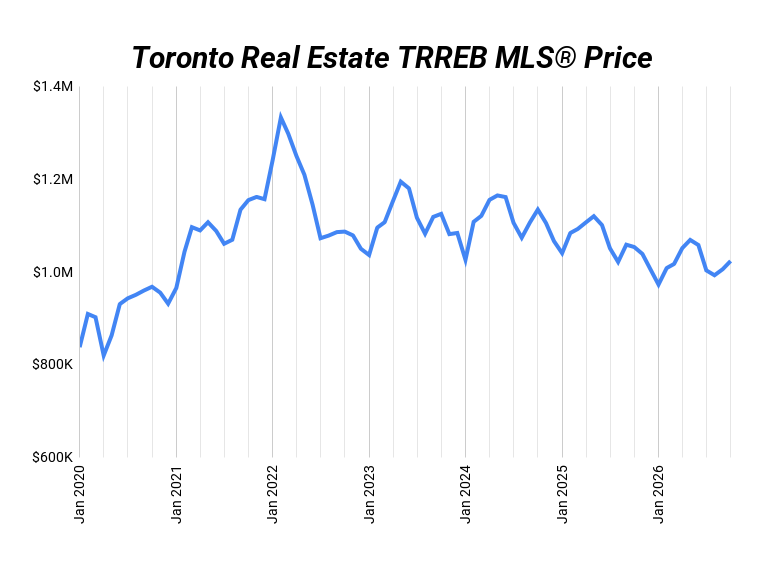
Toronto also isn’t one market. It depends on the type of home. Here’s how the average price changed in the City of Toronto from October 2025 to October 2026, and how each type sold against asking.
| Home Type | Avg Price vs. Last Year | Sold vs. Asking | Days on Market |
|---|---|---|---|
| Semi-detached | +0.5% | 102% | 18 |
| Detached | -1.2% | 97% | 24 |
| Condo apartment | -5.6% | 97% | 36 |
Source: TRREB Market Watch, October 2026. City of Toronto (416).
Semis are the only type still selling over asking, and they sell fastest. Detached homes are flat on price but selling under asking. Condos are down the most and take the longest to sell. For more monthly numbers, see our Toronto real estate market updates.
Where Toronto Houses Sell Over and Under Asking
Where you buy matters as much as what you buy. We looked at every Toronto district for detached homes and semis, and ranked them by how far above or below asking they sold in October.
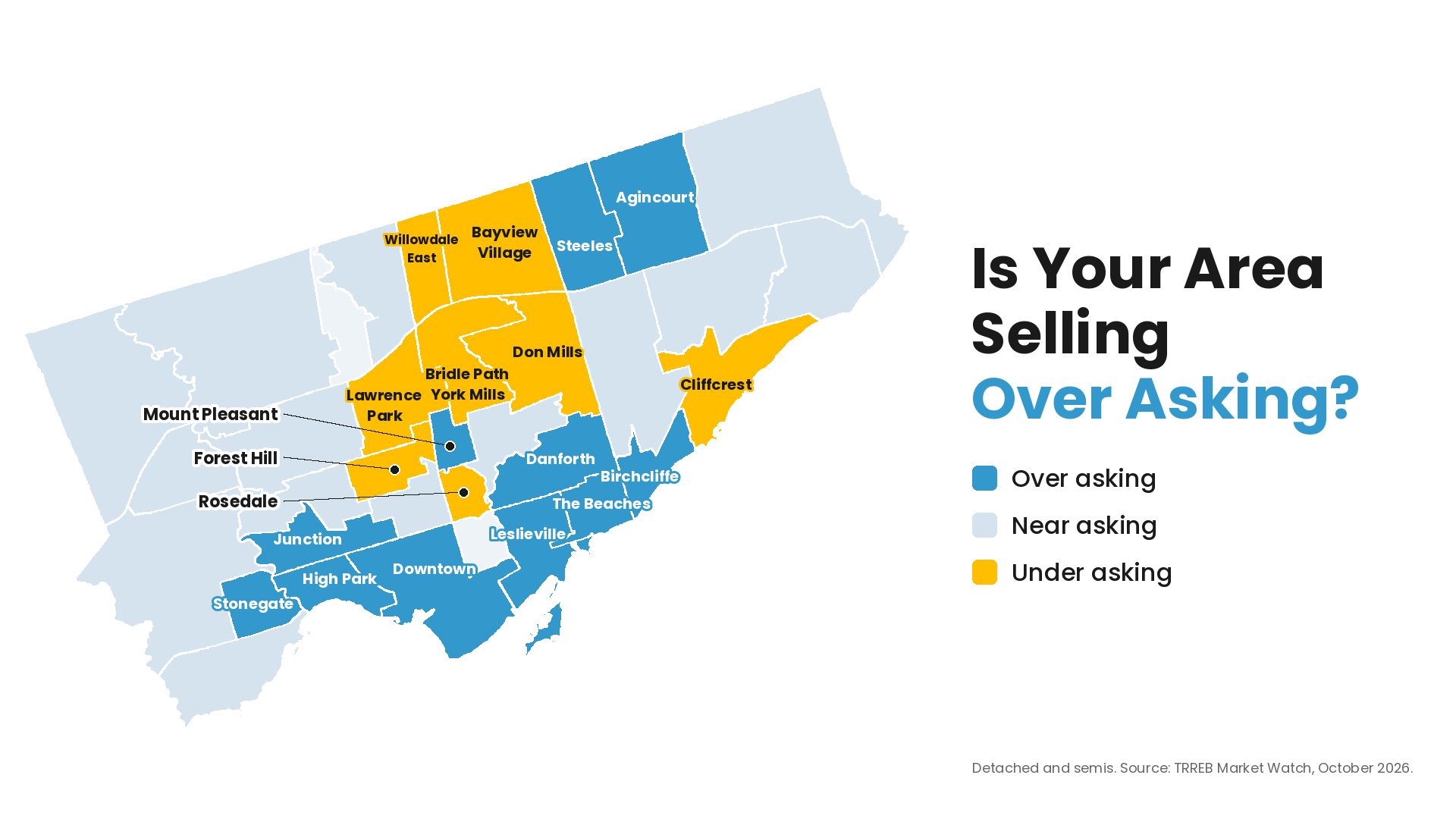
| Strongest for Sellers: East End Semis Leslieville semis sold for 108% of asking in 13 days. Semis in The Beaches sold for 105% and Danforth semis for 103%, all in about 2 weeks. |
| Value Buy: North York and Central Detached Bridle Path, Rosedale, Don Mills and Bayview Village detached homes sold for 93% to 94% of asking. Good value if you’re buying your own home, but the cash flow doesn’t work well as a rental. Prices are too high for the rents. |
| Value and Cash Flow: Downtown For investors, downtown semis and detached homes give the best mix. You get good value today and strong cash flow too. |
| Skip as an Investment: Condos At the end of October, there were 5,251 condo apartments for sale in Toronto, and only 949 sold that month. That’s less than 1 in 5. The rents can’t carry the property, and if you need to sell, it’s hard to get out. |
Source: TRREB Market Watch, October 2026. Areas with at least 10 detached or semi sales.
What’s Happening With Toronto Rents
According to Zumper, Toronto rents are about 18% to 22% below their peak. A 1 bedroom went from $2,547 at its peak to $2,099 today. A 2 bedroom went from $3,470 to $2,745, and a 3 bedroom from $4,558 to $3,550.
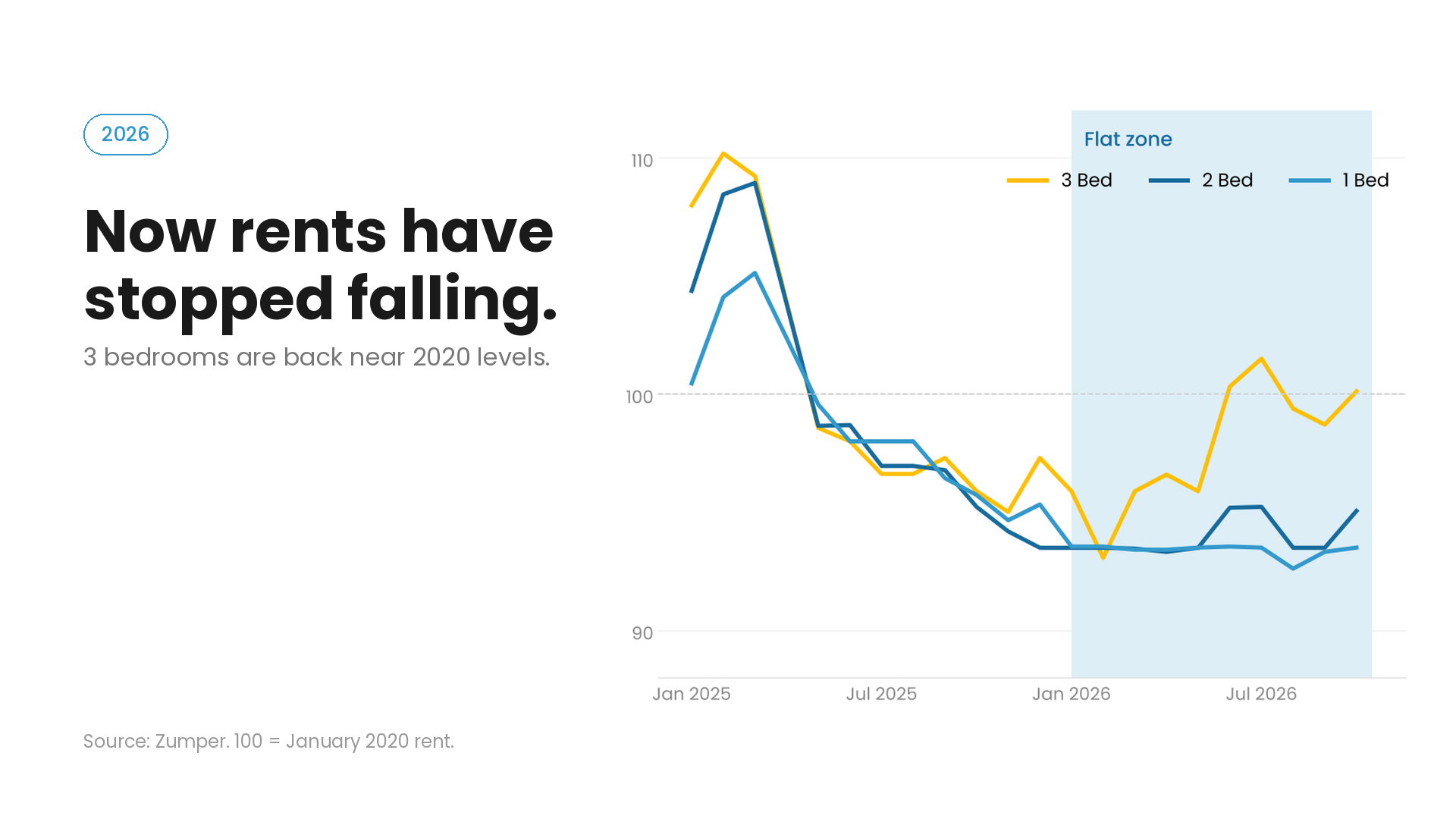
But just like prices, rents have stopped falling. 1 and 2 bedroom rents have barely moved since January. 3 bedroom rents are actually starting to creep back up.
Two forces are pulling on Toronto rents. On one side, mortgage rates are rising. That makes buying harder, so more people keep renting, and that pushes rents up. On the other side, a lot of new condos are still finishing. When owners can’t sell, many rent the unit out instead. That adds supply and keeps rents in check. So for now, plan on rents staying about where they are. Don’t count on them jumping.
How the Rate Hike Changes the Math
The last time rates went up, in 2022, the GTA average price was at its peak of $1,334,544. Today it’s about 23% below that. But back then, rates were coming off record lows, and the Bank of Canada raised them by more than 4 points. This time, markets expect much smaller hikes, about 1 point in total. So we’re not saying 2022 is about to repeat. You can follow where rates may go next on our Canada interest rate forecast.
The direction still matters, because buyers borrow based on the payment they can afford. Fixed mortgage rates have gone from about 4% to around 4.65%. Here’s what that does to the payment on a Toronto property with an $800,000 mortgage.
| Mortgage amount | $800,000 |
| Monthly payment at 4.0% fixed | $4,208 |
| Monthly payment at 4.65% fixed | $4,495 |
| Extra cost each month | +$287 (about 7%) |
| Price drop needed to keep the payment the same | About 6% |
Based on a 25-year amortization. For educational purposes only. Actual figures may vary.
For the next buyer’s payment to stay the same, prices would need to come down about 6%. So there are real reasons for Toronto prices to stay weak. Want to see your own numbers? Try our mortgage calculator.
How to Buy Smart in a Flat Market
Flat prices and rising rates mean the return has to come from the deal, not the market. Here’s how we’re helping Toronto investors buy right now.
1 |
Negotiate Hard Toronto detached homes are selling for 97% of asking on average and taking 24 days. For homes that have been sitting longer, go lower. Start around 10% under and see where things land. A 10% discount today beats waiting for a 6% drop that may never come. |
2 |
Stress-Test Every Deal Run the numbers at the higher fixed rate, even if you’re going variable. Use today’s rents, not what you hope rents will be next year. If it still cash flows, it’s a deal. |
3 |
Look at Value-Add Projects Refreshing a tired Toronto house and adding units is how you make your own return. You get a higher property value and stronger cash flow, instead of waiting for the market to do it for you. |
4 |
Beat the Condo Pile Your rentals compete with thousands of Toronto condos. Bigger units, private entrances and outdoor space are things condos can’t offer, and they get you better tenants. |
Here are two Toronto deals we’re looking at for clients right now. To see more, check our Deal of the Week.
Turnkey 3-Unit Semi
| Purchase price | $800,000 |
| Cash in (20% down, closing costs, $50K finishing work) | $236,450 |
| Total rent (3 bed, 2 bed, 1 bed) | $7,300/mo |
| Cash flow | $2,921/mo |
Value-Add Triplex Plus Laneway Suite
| Purchase price | $900,000 |
| Cash in to start (20% down, closing costs, $100K renovation) | $310,450 |
| Cash out on refi #1 (3 units) | $240,000 |
| Cash flow after refi #1 | $1,845/mo |
| Cash flow after adding the laneway suite and refi #2 | $3,959/mo |
Projections only, based on a 4.5% interest rate, 20% down and a 30-year amortization, refinanced at 80% of completion value. Actual figures and returns may vary.
Curious how renovation costs, rents and refinances add up on deals like these? See what Toronto multiplexes really cost and earn.
Make Sure the Deal Works at Today’s Rates
Uncertainty isn’t a bad thing. In hindsight, it’s often when the best deals get made. Toronto homes are selling under asking, rents have levelled off and rates are rising, so nobody knows if prices have hit bottom. You don’t need them to. Just make sure the deal works at today’s rates and today’s rents, so you don’t need the market to bail you out.
That takes knowing which areas are selling over asking, where you can negotiate, and which properties can cash flow as a multiplex. That’s the work we do every day.
Our brokerage specializes in Toronto multiplexes. We’ll help you find deals, crunch the numbers, and guide you through renovations and management. If you want full support in Toronto multiplex investing, our team can help you:- Find high-potential properties
- Crunch the numbers so you know exactly where you stand
- Coach you through renovations to maximize returns
- Lock in great tenants
- Provide full property management so your investment runs smoothly
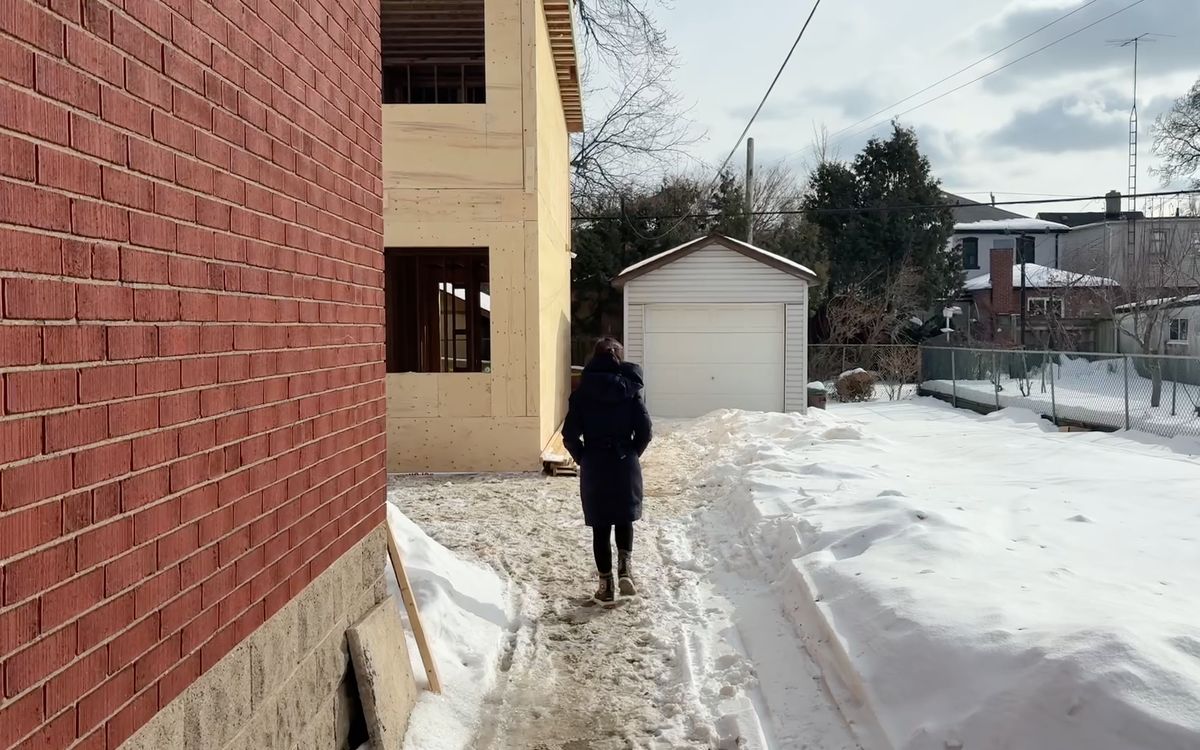
What do Toronto multiplexes really cost and earn?
We pulled the numbers from the 50+ deals we worked on in the past year: build costs, rents by unit type, and how the refinances came out. Free, and no best case.
