The federal and provincial governments announced $8.8 billion in funding for Ontario housing. Toronto secured $1.5 billion of it first. Before any other city in the province. When every level of government points at one city at the same time, real estate investors should pay attention.
This isn’t just a funding headline. It’s the latest move in a policy shift that has been building for three years. Toronto has been quietly removing the barriers that stopped investors from building more housing. This announcement is the biggest one yet, and if you’re investing in Toronto multiplexes right now, or thinking about it, here’s exactly what changed and what it means for you.
What Are Development Charges and Why Did They Kill Projects?
Every time someone builds a new unit in Toronto, the city charges a fee called a development charge, or DC. This money pays for the roads, sewers, transit, and water systems that new residents will use. It’s how the city funds growth without passing the cost to existing taxpayers.
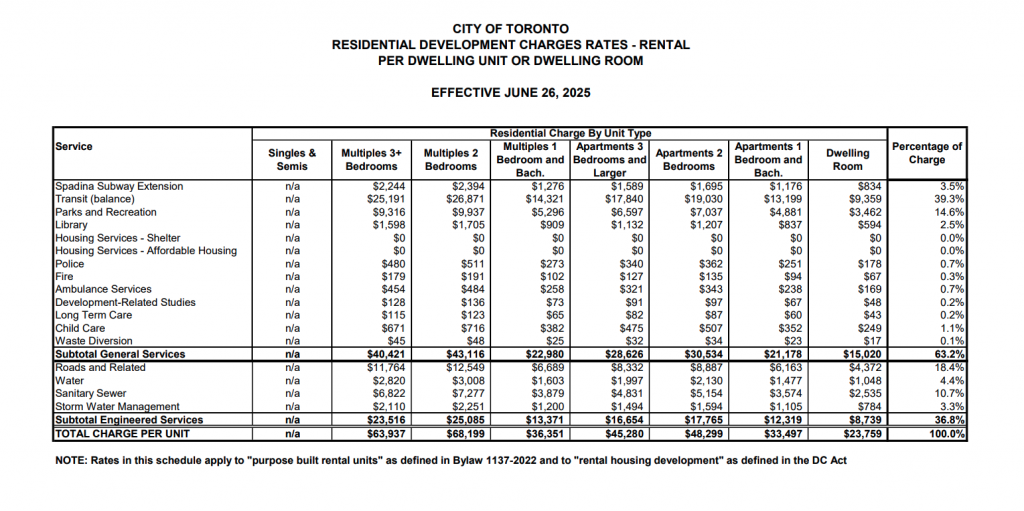
The problem was the size of the fee. Development charges used to run up to $50,000 per unit in Toronto. Build a three-unit multiplex and you’re looking at $150,000 in DCs before you’ve done a single thing to the building. That’s on top of land, construction, and financing costs. For most investors, those numbers simply didn’t work. It’s one of the biggest reasons multiplex projects didn’t get built in Toronto for years.
This wasn’t a secret. Developers, investors, and housing researchers all pointed to development charges as a major barrier. The math was clear: high DCs made small and mid-size housing projects unviable. So the city started fixing it.
What Toronto Has Been Doing Since 2023
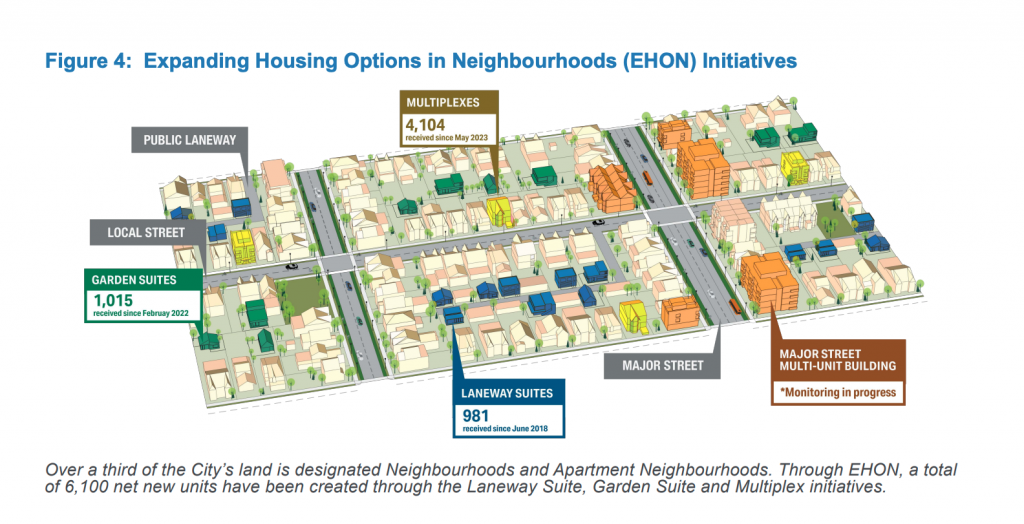
For close to 20 years, almost nothing changed in Toronto’s housing rules. Then, starting in 2023, changes started coming quickly. In 2023, the city legalized fourplexes on almost every residential lot in Toronto. Before that, you needed rezoning, variances, and months of waiting just to add a unit. Now it’s as-of-right. You apply for a building permit and get approved in weeks.
In 2025, Toronto went further. The city waived development charges entirely for buildings up to six units. This applied to properties in Old Toronto, East York, and parts of Scarborough. Toronto was awarded around $460 million from the federal government for making that move. The incentive worked. Since fourplexes became legal, Toronto has created over 4,100 new multiplex units. You can read more about the current Toronto sixplex and multiplex rules here.
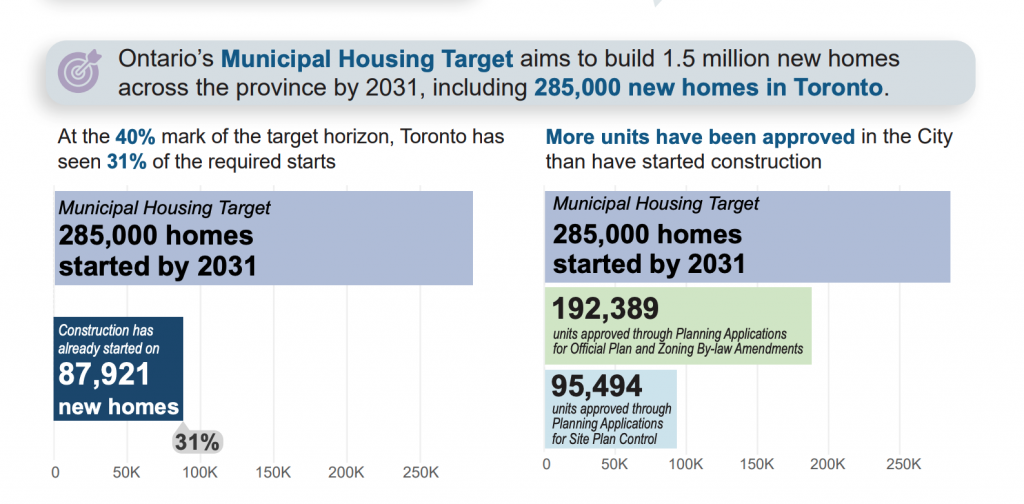
But Toronto still has a problem. The city’s target is 285,000 new housing starts by 2031. We’re 40 percent of the way through that timeline and have only hit 31 percent of the target. Small multiplexes are helping, but they’re not enough. To hit the targets, the city needs bigger projects to start pencilling out too.
The June 23rd Announcement: $1.5 Billion
On June 23rd, 2026, Toronto announced it had secured $1.5 billion from the federal and provincial governments through the Development Charge Reduction Program. Toronto was first in Ontario. In exchange, the city committed to cutting development charges by 40 to 60 percent on all residential types, and that reduction runs from now until at least 2029.
Here’s why that matters for larger projects. Once you go past six units, development charges kick back in at around $50,000 per unit. On a 10-unit building, that’s roughly $200,000 in development charges before you’ve started construction. That cost alone was killing projects before they started. Nobody was seriously looking at 7, 8, or 10-unit buildings in Toronto because the numbers didn’t work.
A 40 to 60 percent cut changes that math. The exact updated rate schedule hasn’t been published yet, but a 50 percent reduction on a 10-unit project could mean saving $100,000 or more in soft costs. That’s the difference between a project that works and one that doesn’t. If you’ve passed on a larger build in the last few years because of DC costs, it’s worth running the numbers again.
Who This Actually Affects
If you’re a smaller investor doing a triplex or a sixplex conversion, this announcement doesn’t change your numbers. Your development charges were already zero. The DC waiver for up to six units was already in place, and that’s still there. This announcement was never about you.
This is about builders who want to scale. The investors and developers targeting 10, 20, or even 60 units on major streets who couldn’t make the math work because of that $50,000 per unit DC wall. With up to a 60 percent cut, projects that didn’t pencil out before are worth looking at again. The barrier got shorter.
There’s also a second program worth knowing about. Toronto launched phase two of its Purpose-Built Rental Incentive, which provides an indefinite deferral of development charges for projects that include at least 20 percent affordable housing. That deferral can improve cash flow significantly during construction. The program prioritizes shovel-ready projects and reviews applications on a rolling basis. If you have a project in permitting with a rental component, this is worth looking at now.
The Bigger Picture: Three Levels of Government Moving Together
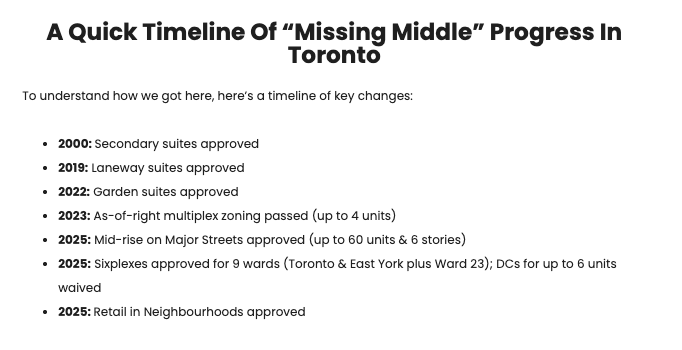
The $1.5 billion is significant on its own. But the more important thing is what it represents. This is part of a consistent pattern. Toronto legalized fourplexes. Waived DCs on six units. Cut property taxes on new multi-residential builds. Allowed 60 units on major streets. Added laneway suites and garden suites. And now secured the largest housing infrastructure award in Ontario. These aren’t isolated moves. They’re a deliberate direction.
Compare that to cities like Oakville, which looked at the same Development Charge Reduction Program and chose not to participate. Other municipalities across Ontario pushed back or hesitated. Toronto went all in and got the biggest piece of the funding. When the federal government, the provincial government, and the city are all pointing in the same direction at the same time, that’s not a coincidence. That’s a signal.
The city hasn’t hit its housing targets yet. That means more pressure is coming, and more incentives are likely on the way. If you’re investing in Toronto multiplexes right now, you’re moving with the current, not against it. Lower purchase prices, a buyer’s market, lower construction costs, and better cash flow are already in place. The policy environment is only getting more favourable for investors who are willing to add rental housing to the city’s supply.
The Bigger Picture: Three Levels of Government Moving Together
The $1.5 billion is significant on its own. But the more important thing is what it represents. This is part of a consistent pattern. Toronto legalized fourplexes. Waived DCs on six units. Cut property taxes on new multi-residential builds. Allowed 60 units on major streets. Added laneway suites and garden suites. And now secured the largest housing infrastructure award in Ontario. These aren’t isolated moves. They’re a deliberate direction.
Compare that to cities like Oakville, which looked at the same Development Charge Reduction Program and chose not to participate. Other municipalities across Ontario pushed back or hesitated. Toronto went all in and got the biggest piece of the funding. When the federal government, the provincial government, and the city are all pointing in the same direction at the same time, that’s not a coincidence. That’s a signal.
The city hasn’t hit its housing targets yet. That means more pressure is coming, and more incentives are likely on the way. If you’re investing in Toronto multiplexes right now, you’re moving with the current, not against it. Lower purchase prices, a buyer’s market, lower construction costs, and better cash flow are already in place. The policy environment is only getting more favourable for investors who are willing to add rental housing to the city’s supply.
Is Now the Right Time to Build or Buy in Toronto?
Toronto’s DC reduction is the most significant shift in the cost of building larger residential projects in years. For investors who have been watching from the sidelines, the window to act has opened. Lower development charges, a buyer’s market on acquisitions, and a government that is actively funding the infrastructure to support more housing is a combination that hasn’t existed before in this city.
Whether you’re looking at a sixplex conversion, a larger purpose-built rental, or trying to figure out where to start, the numbers are worth running now. Use our total return calculator to see how a Toronto multiplex could perform for your situation.
Our brokerage specializes in Toronto multiplexes. We’ll help you find deals, crunch the numbers, and guide you through renovations and management. If you want full support in Toronto multiplex investing, our team can help you:- Find high-potential properties
- Crunch the numbers so you know exactly where you stand
- Coach you through renovations to maximize returns
- Lock in great tenants
- Provide full property management so your investment runs smoothly

What Toronto Real Estate Investment Is Right For You?
Check out our complete Toronto real estate investment guide for all the details and real-life examples. If you’re ready to dive in, just book a call with us!
This is for educational purposes only; it does not guarantee future performance or serve as financial or tax advice.
