If you’re waiting for Toronto real estate to recover before you buy a multiplex, here’s what most people miss. When this market turns, rents usually move first. Prices follow later. So if you’re only watching prices, you’re watching the wrong thing if you want to act early.
Right now, Toronto prices are down about 25% from the February 2022 peak. Rents are down too. And interest rates are turning back up. Everything is moving the wrong way, and waiting feels like the only sane choice.
Real estate people have been calling the bottom every year since 2022. Honestly, nobody knows how long this lasts. What we can show you is how the cycle works, and the 3 signs to look out for, so you can spot the turn yourself.
The 3 Forces That Move Toronto Prices and Rents
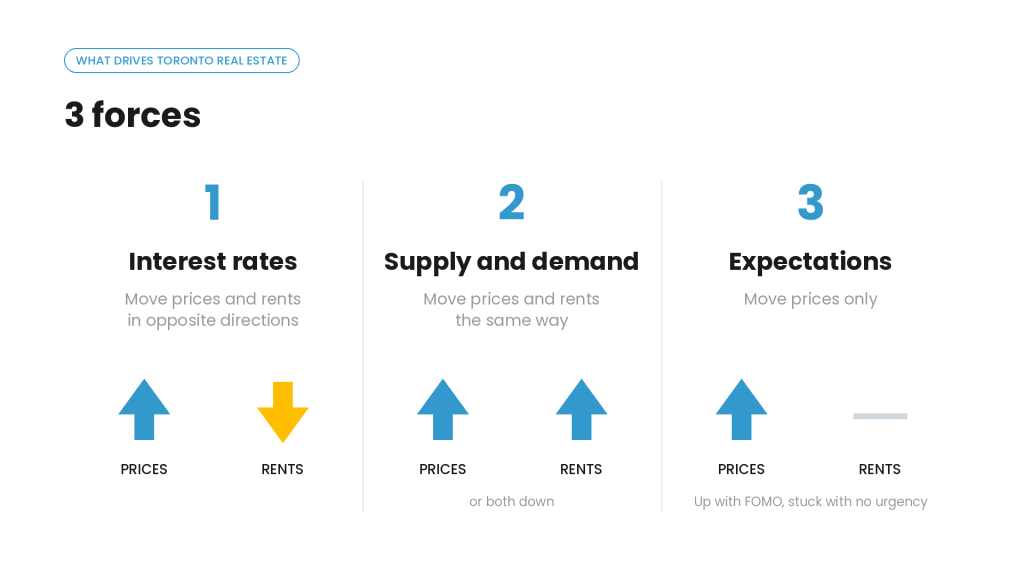
The first force is interest rates. Rates decide who rents and who buys. When rates are low, renters buy. They move out, so rents soften while prices rise. When rates are high, buyers get priced out and keep renting. Prices fall, and rents go up. That’s why prices and rents usually move in opposite directions, like a seesaw.
The second force is supply and demand. Are there more people with jobs looking for homes, or more homes than people? This one pushes prices and rents the same way. Too few homes, and both go up. Too many homes, and both go down.
The third force is expectations, and it only hits prices. When people think prices will rise, FOMO pushes prices way up. When they think prices will fall, or just won’t go up anytime soon, there’s no rush. So they wait, even if buying gets cheaper. Whichever of these 3 forces is strongest decides which stage of the cycle we’re in.
The 4 Stages of the Toronto Real Estate Cycle
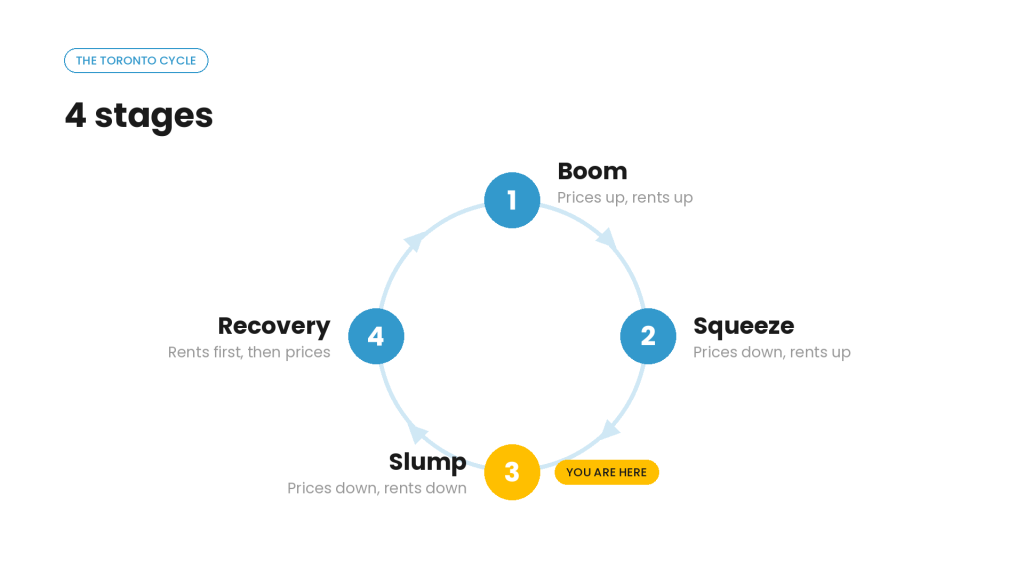
Stage 1 is the boom. Prices up, rents up. Cheap money, lots of people, and everyone wants in. Toronto had one from 2015 into early 2017. It ended when expectations flipped, right after Ontario’s foreign buyer tax in April 2017. Rates and supply barely changed. Buyers just stopped believing prices would keep climbing.
Stage 2 is the squeeze. Rates jump, prices fall and rents rise. Buyers who can’t qualify keep renting, so fewer units open up. Toronto saw a small squeeze in 2018, and a big one in 2022 and 2023. In 2023, the average Toronto 2 bedroom asking rent jumped about 13% in a single year.
Stage 3 is the slump. Prices down, rents down, and this is the part that trips people up. Rates were cut in 2024 and 2025. A few months ago, the monthly payment on an average Toronto home was about $500 less than at the 2022 peak. But buyers still didn’t come back. Toronto home sales fell about 11% in 2025. There was no urgency. Prices weren’t bouncing back anytime soon, so why rush?
Rents fell about 4% in 2025 too. The condo wave from the boom years finished just as Toronto’s population stalled. Statistics Canada has the Toronto area adding a record 268,911 people in the year to July 2024. The next year, it shrank by about 1,000. That’s where we are today.
Stage 4 is the recovery. Supply and demand get back in balance, and rents start to rebound. Then the numbers start working again for investors, and prices follow. Toronto saw this in 2019, right after the 2018 squeeze.
Why Toronto Rents Recover Before Prices
Renting is a need. Buying is a choice. New demand almost always starts as renters. That’s newcomers to Canada, people moving to Toronto for work, and young people moving out of their parents’ place. They need a home now. They can’t wait for the market to feel better.
Buyers can wait, and high rates make them wait even longer. Higher rates hurt confidence and cap how much buyers can borrow. So buyers and investors sit on their hands. Renters don’t get that choice.
That’s why, when demand comes back while rates are still up, it goes straight to the rental market. Rents feel it first. Once rents rise, the numbers start to work for investors again, and that’s what pulls prices up behind them.
3 Signs the Toronto Real Estate Slump Is Ending
Sign 1: Rental vacancy. When fewer units sit empty, landlords stop cutting rents. CMHC’s rental market survey comes out every winter, and Ontario’s vacancy rate was about 3.2% in 2025. Watch this number. When it starts to hold steady or fall, that’s a key sign.
Sign 2: Immigration. The new federal immigration targets come out by November 1, and Statistics Canada updates population every quarter. Ottawa has already cut its permanent resident target to 380,000 a year for 2026. If Toronto starts growing again, rental demand comes back fast.
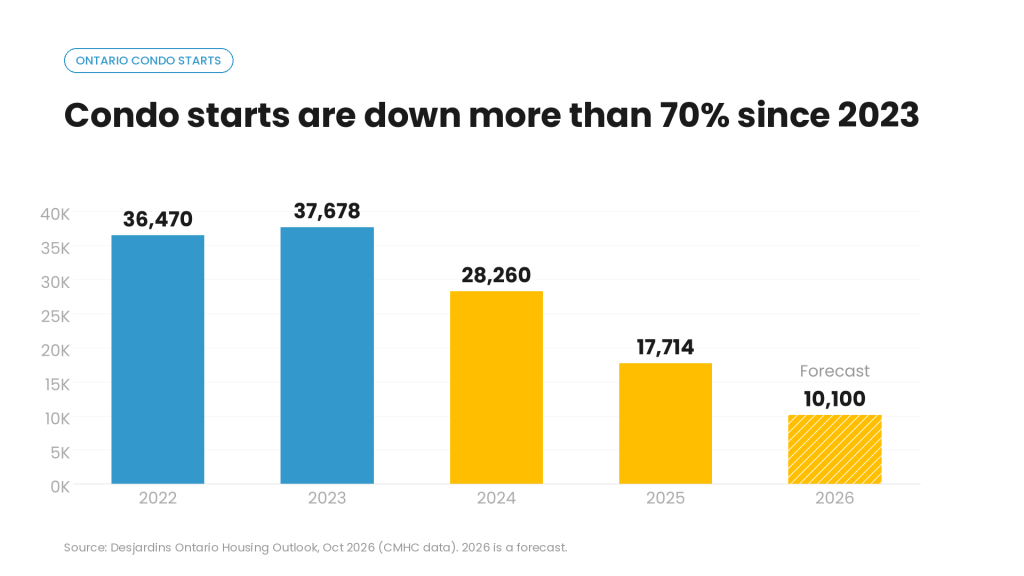
Sign 3: Condo starts and completions. Condo construction in Toronto has almost stopped. Only 525 condo units were started in the City of Toronto in the first 9 months of 2026, compared with nearly 14,000 a year over the previous decade. But condos take 4 to 5 years to build, so the ones from the boom years are still finishing. When completions drop off, the extra supply is gone, and very little is coming behind it.
How to Buy a Toronto Multiplex in a Slump
If you want to buy today, be conservative. Use conservative rents, and run your numbers at today’s fixed rates, even if you’re going variable. If that rate is about 1% higher than what you’ll actually pay, the price needs to be about 10% lower to keep the same monthly payment. For example, a $1.3 million triplex at 3.5% has about the same payment as a $1.155 million triplex at 4.5%, with 20% down over 30 years.
But you don’t have to wait for the whole Toronto market to drop 10%. Find one motivated seller today. Someone who needs to sell will often take the price you’re hoping the market hits next year. In a slump, there are more motivated sellers than usual, and they care more about certainty than squeezing out the last dollar.
When you get the price right, the numbers can look really good. Here’s a deal we’re seeing right now: a turnkey Dufferin Grove triplex at $1,199,000, with rents of $3,000, $2,500 and $2,000. With 20% down at a 4.5% rate, it cash flows about $1,266 a month after the mortgage, tax and bills. You can test deals like this with our total return calculator.
If you’re planning a multiplex conversion, build units the condo wave doesn’t compete with. Think family-sized units in a low-rise, with their own entrance. A 1 bedroom competes head-on with every new condo for rent in Toronto. A 2 or 3 bedroom with its own door is much harder to find.
Should You Wait or Buy a Toronto Multiplex Now?
Nobody knows exactly when the Toronto slump ends. But you don’t need to time the bottom. If a deal works at conservative rents and today’s fixed rates, and you’ve found a seller at the right price, you’re in good shape whichever way the market goes.
That’s where an experienced team helps. Finding motivated sellers, stress-testing the numbers and choosing the right unit mix is what we do every day. We’re investors too, and we’ll tell you honestly if we’d wait.
Our brokerage specializes in Toronto multiplexes. We’ll help you find deals, crunch the numbers, and guide you through renovations and management. If you want full support in Toronto multiplex investing, our team can help you:- Find high-potential properties
- Crunch the numbers so you know exactly where you stand
- Coach you through renovations to maximize returns
- Lock in great tenants
- Provide full property management so your investment runs smoothly

What Toronto Real Estate Investment Is Right For You?
Check out our complete Toronto real estate investment guide for all the details and real-life examples. If you’re ready to dive in, just book a call with us!
This is for educational purposes only; it does not guarantee future performance or serve as financial or tax advice.
