A client asked us this exact question last week. One bedroom, two bedroom, or three bedroom units, what’s actually better for a Toronto multiplex? It matters more than most investors think, because it decides what kind of house you should be looking for before you even start your search.
Unit mix changes your rent, your turnover, and how much time you spend managing tenants over the next ten years. In this post we break down the real numbers on all three unit sizes, including what happens to your net income once you factor in leasing fees and vacancy time, and how unit mix affects your cap rate.
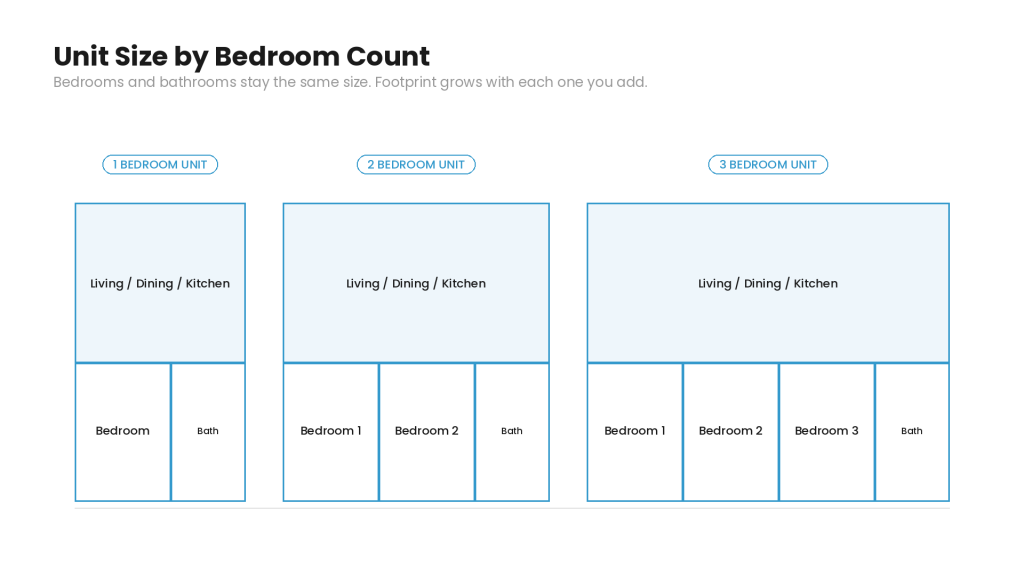
Why We Tell Clients to Skip the 1 Bedroom
A lot of investors think more units always means more money. So they chop a house up into as many bachelor or one bedroom units as it’ll allow. On paper that can bring in more total rent. But smaller units turn over a lot more often, and every turnover costs time or money, sometimes both.
One bedroom units are also competing directly with purpose built condos, and there’s a ton of condo supply in Toronto right now. That makes a converted one bedroom harder to rent, even though it’s usually cheaper than a condo. You end up with either a vacant unit or a lower rent to fill it.
This is exactly why unit mix needs to be planned before you tour houses, not after. If a property can fit a two bedroom unit instead of a one bedroom, even by adding a couple of walls, it’s usually worth it. A two bedroom renting at $2,500 beats a one bedroom at $2,000, and it comes with a steadier tenant too.
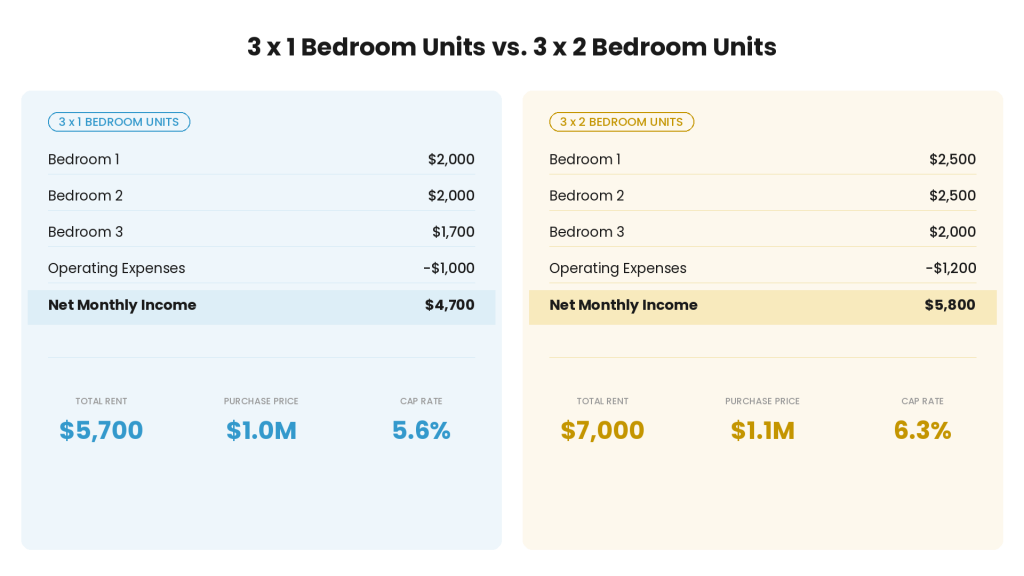
2 Bedroom vs. 3 Bedroom, the Real Trade Off
Two bedroom units tend to be the sweet spot for most Toronto multiplex investors. They attract working couples, roommates, and anyone who wants a bit more space than a one bedroom without going all the way to a family sized unit. Two bedroom tenants also turn over more than families do, usually every few years, which lets you bring rent up to market more often than the province’s rent increase guideline allows.
Three bedroom units attract two very different tenant types, families and roommate groups, and which one you land changes how the unit behaves. Families rarely move once the kids are settled into a school, so you get fewer vacancies and less turnover stress. The trade off is you’re not marking to market as often, so you give up some upside for that stability.
Roommate groups on a three bedroom lease are a bit more hands on. When one of three tenants wants to move out, the lease usually just stays in place while the group finds a replacement, so it’s not really a problem, just a bit more management than a family tenancy.
What Higher Rent Might Cost You Over Time
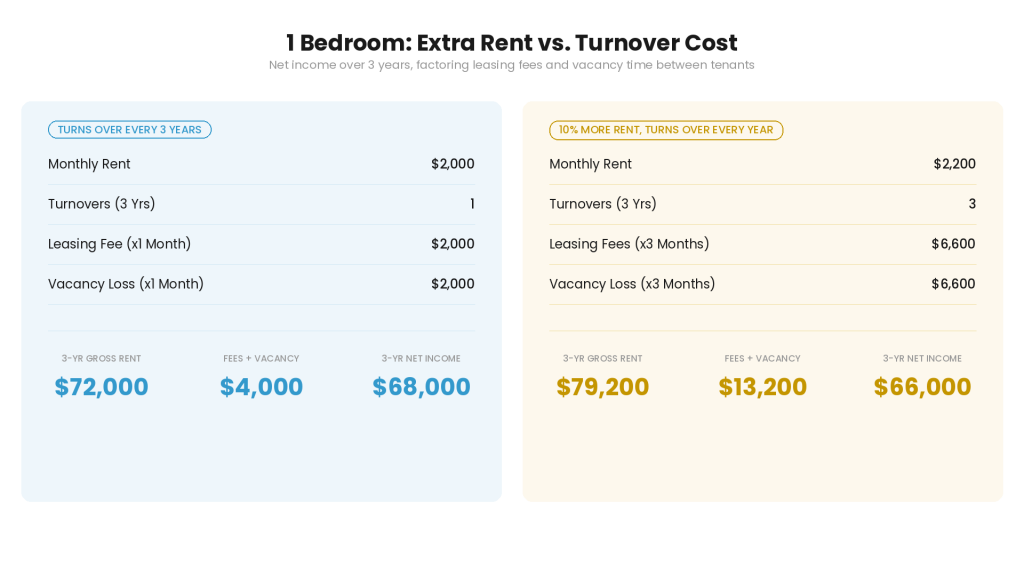
Say you can get 10% more rent on a 1 bedroom unit, but it turns over every year instead of every three years. That extra rent looks good on paper, but it’s worth running the full numbers before deciding it’s the better option.
Over 3 years, a unit renting for $2,000 with one turnover brings in $72,000 in gross rent. After a $2,000 leasing fee and roughly a month of vacancy between tenants, that’s $68,000 in net income. The same unit at $2,200 a month, turning over every year, brings in $79,200 in gross rent, but three leasing fees and three vacancy periods bring net income down to $66,000.
The stable tenant comes out about $2,000 ahead over three years, even while collecting less rent every month. This is the real question behind every unit mix decision: do you prioritize higher rent today, or higher long term rent once you factor in the costs and time that come with more turnover?
Getting Your Unit Mix Right From the Start
Unit mix is one of the first decisions you’ll make on a Toronto multiplex, and it shapes your rent, your tenant pool, and your cap rate for years after closing. Getting it right before you buy or convert is a lot easier than fixing it after the fact.
Our brokerage specializes in Toronto multiplexes. We’ll help you find deals, crunch the numbers, and guide you through renovations and management. If you want full support in Toronto multiplex investing, our team can help you:- Find high-potential properties
- Crunch the numbers so you know exactly where you stand
- Coach you through renovations to maximize returns
- Lock in great tenants
- Provide full property management so your investment runs smoothly

What Toronto Real Estate Investment Is Right For You?
Check out our complete Toronto real estate investment guide for all the details and real-life examples. If you’re ready to dive in, just book a call with us!
This is for educational purposes only; it does not guarantee future performance or serve as financial or tax advice.
