Canada’s inflation came in at 3.1% on October 19, 2026. That same day, markets put the odds of a Bank of Canada rate hike on October 28 at about 75%. If you own a Toronto multiplex, or you’re thinking of buying one, that headline probably made your stomach drop.
Here’s the short version. On a $960,000 mortgage, each quarter-point hike adds about $140 a month to your payment. That’s real money, but it’s not what breaks a deal. What breaks a deal is not knowing if it still works at higher rates, and what price makes sense now. In this post, we’ll walk through why the Bank might hike, how it hits fixed and variable mortgages, what happened last time, and the real numbers on a Toronto triplex.
Why Is the Bank of Canada Thinking About a Rate Hike?
September’s 3.1% inflation is being pushed up by gas. Statistics Canada says gas prices were up about 28% from a year ago, as oil jumped with the conflict in the Middle East. Take gas out, and inflation was 2.2%. The Bank’s own core measures, the ones it watches most closely, were even lower at 1.8% and 1.9%. That’s under the Bank’s 2% target.
Here’s the part that trips people up. The inflation number barely moved the odds of a hike. On October 9, after Canada lost 68,000 jobs, markets put the odds of an October hike at about 27%. They jumped over the weekend of October 17 and 18, after Governor Tiff Macklem warned that high energy prices could push inflation up from here. So if the Bank hikes, it’s reacting to oil and what it’s worried about next, not to Toronto housing.
The forecasters don’t agree on what comes after. Markets are pricing a second hike by December 9, and Manulife has called for hikes at both meetings. Looking further out, TD and BMO see the Bank’s rate staying at 2.25% through 2027, while RBC sees 3.25% and Scotiabank sees 3%. When the big banks are that far apart, nobody knows. Don’t plan around a guess. If oil drops and jobs keep weakening, this hike talk could fade fast. If inflation outside of gas starts climbing, that changes things.
Fixed vs Variable: Which Toronto Mortgages Feel a Rate Hike?
A hike aimed at oil still lands on your mortgage. How it lands depends on your rate type. Fixed rates follow the 5-year bond yield, not the Bank of Canada’s rate. That yield was 3.19% in late July and 3.59% on October 19. So fixed rates have already moved, from about 4% this summer to about 4.5% today. A lot of the hike is already priced in.
Variable rates are different. They move with the Bank of Canada’s rate, one for one. The Bank’s rate is 2.25% and prime is 4.45%, and the best variable rates in Toronto are around 3.5%. If the Bank hikes by a quarter point on October 28, prime goes to 4.70% and variable rates go up the same day, to around 3.75%.
If you have a variable mortgage, check how your lender handles a hike. Some keep your payment the same and pay down less principal. Others raise your payment right away. If yours goes up with prime, leave room in your cash flow for rates at 4.5% or even 4.75%.
What Happened to Toronto Real Estate the Last Time Rates Went Up?
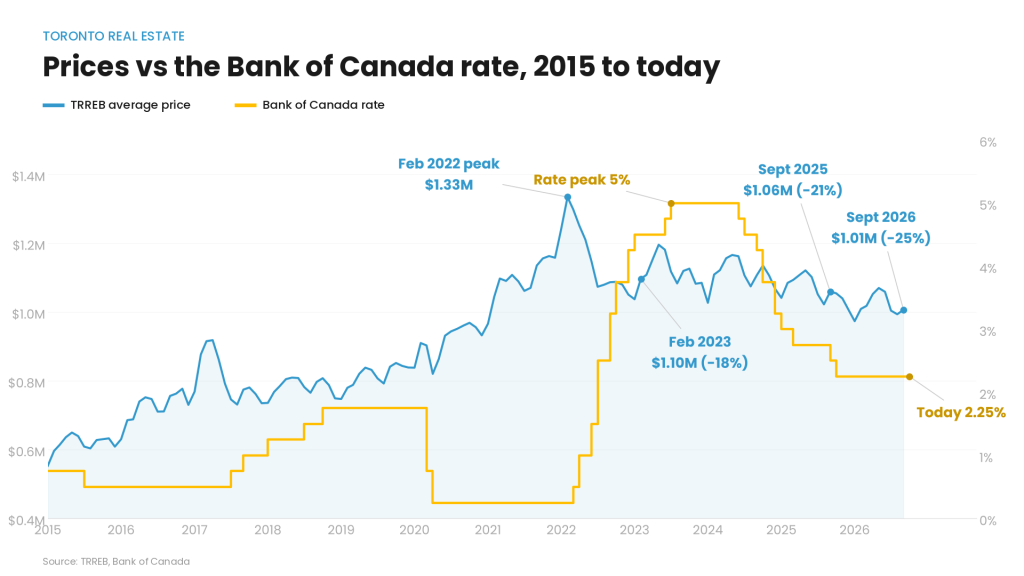
The last round of hikes began in March 2022. February 2022 was the peak for Toronto real estate, with a TRREB average price of $1.33 million. A year later, the average was about 18% lower, and sales were down 47%.
But be careful with that pattern. In 2022, the Bank started at 0.25% and raised rates to 5% in about a year and a half. Toronto was also coming off a frenzy, where homes in February 2022 sold for 16% over asking on average. Today, the starting rate is 2.25%, and markets are pricing a peak of about 3.25% to 3.5% around the end of 2027.
Toronto prices have also already come down. TRREB’s September 2026 average was about $1 million, roughly 5% lower than a year ago and about 25% below the 2022 peak. So the shock that hit Toronto in 2022 isn’t the setup we’re in now. On the ground, we’re seeing fewer people ready to buy right away. The ones who do call us are asking sharper questions about cash flow, and they want to see the numbers at a higher rate before they commit.
What a Rate Hike Does to a $1.2 Million Toronto Triplex
Say you’re buying a $1.2 million triplex in Toronto with 20% down. That’s a $960,000 mortgage on a 30-year amortization. Here’s what your monthly payment looks like at summer rates, today’s rates and the market’s expected peak.
| Rate | When | Monthly payment | Change |
|---|---|---|---|
| 4% | Fixed, summer 2026 | $4,565 | Starting point |
| 4.5% | Fixed, today | $4,840 | +$275 |
| 4.75% | Variable at expected peak | $4,980 | +$415 |
Here’s another way to see it. To get the same $4,565 payment you’d have had at 4%, the triplex needs to come in about 6% lower at today’s rates, or around $1.13 million. At the expected peak, it needs to be about 8% lower, or around $1.1 million. That’s the price a rate hike has to be worth to you.
That doesn’t mean waiting for the whole market to drop. It means knowing your number before you make an offer. If a seller won’t move off a summer price, the math just got worse for you. If you can negotiate that gap, the higher rate doesn’t hurt you at all. Plug your own numbers into our total return calculator to see where you land.
What Toronto Multiplex Investors Should Do Now
First, run every deal at 4.75%, whether you’re going fixed or variable. If the numbers still work there, a hike won’t sink you. If a deal only works at today’s rates, it doesn’t really work.
Second, property type matters more than ever. Condos and single-family homes are hard to cash flow in a normal market, and higher rates make that harder. A multiplex spreads the mortgage across more rents. If you can add a garden suite or laneway suite, that’s one more rent against the same mortgage, and current government rebates help make the build make sense.
Third, use the slow market. GTA sales were down 9% from a year ago in September, so most sellers aren’t getting multiple offers on offer night. That gives you time to put in conditions, get an inspection and contractor quotes, and run your numbers before you firm up. Back in 2022, Toronto buyers had to skip all of that just to compete.
And honestly, some of you should wait. If your plan only works with rates going down, wait. If you can’t keep 6 months of payments in the bank, wait until you can.
Know Your Number Before the Next Rate Decision
A Bank of Canada hike isn’t the same as your property not working. It’s the same deal at a slightly higher cost. The investors who come out ahead are the ones who know the price that works at today’s rates and negotiate to it, instead of guessing where rates go next.
That’s where it helps to have a team that runs these numbers every day. We’ll stress test your deal at higher rates, look at whether a suite could add income, and tell you honestly if we’d pass.
Our brokerage specializes in Toronto multiplexes. We’ll help you find deals, crunch the numbers, and guide you through renovations and management. If you want full support in Toronto multiplex investing, our team can help you:- Find high-potential properties
- Crunch the numbers so you know exactly where you stand
- Coach you through renovations to maximize returns
- Lock in great tenants
- Provide full property management so your investment runs smoothly

What Toronto Real Estate Investment Is Right For You?
Check out our complete Toronto real estate investment guide for all the details and real-life examples. If you’re ready to dive in, just book a call with us!
This is for educational purposes only; it does not guarantee future performance or serve as financial or tax advice.
