This fall, almost 100 investors came out to our kickoff event. A week before, we went to another multiplex event in Toronto. The two events could not have been more different. One was all about big builds: fourplex plus garden suite, sixplexes, and every detail of how to pull them off. At ours, we cut the development talk and went back to basics. We expected people to be let down. Instead, the room was more excited than we thought.
The takeaway was simple. The old strategy still works. Smaller multiplex conversions, like duplexes, triplexes and fourplexes, are still the best fit for most people. If you have a full-time job and want real estate as a side project, this is where the math, the risk and the timeline tend to line up. In this post, we break down why, with real numbers from the Toronto market.
Why Smaller Toronto Multiplex Conversions Still Work
A conversion means taking an existing house and turning it into two, three or four units. You keep the structure. You add a basement suite, split floors, and bring everything up to code. It is a very different project from tearing down a house and building a sixplex from scratch.
Big builds have a place. If you are a builder with your own team, your costs are much lower and you can take on that risk. But most investors are not builders. They pay a builder to do the work, and those fees add up fast. For the average buyer, a triplex or fourplex conversion is much more manageable. The timeline is shorter, the risk is lower, and in many cases the return is even higher.
There is another upside right now. Conversion deals are not as hot as they were. With so much attention on big builds, there is less competition for the kind of houses that make great conversions. One of our long-time clients, who has bought properties all over Ontario, told us at the event that she keeps coming back to Toronto triplexes. In a tough market, the weak deals fall away and the strong ones survive.
Why Bigger Multiplex Builds Carry More Risk Right Now
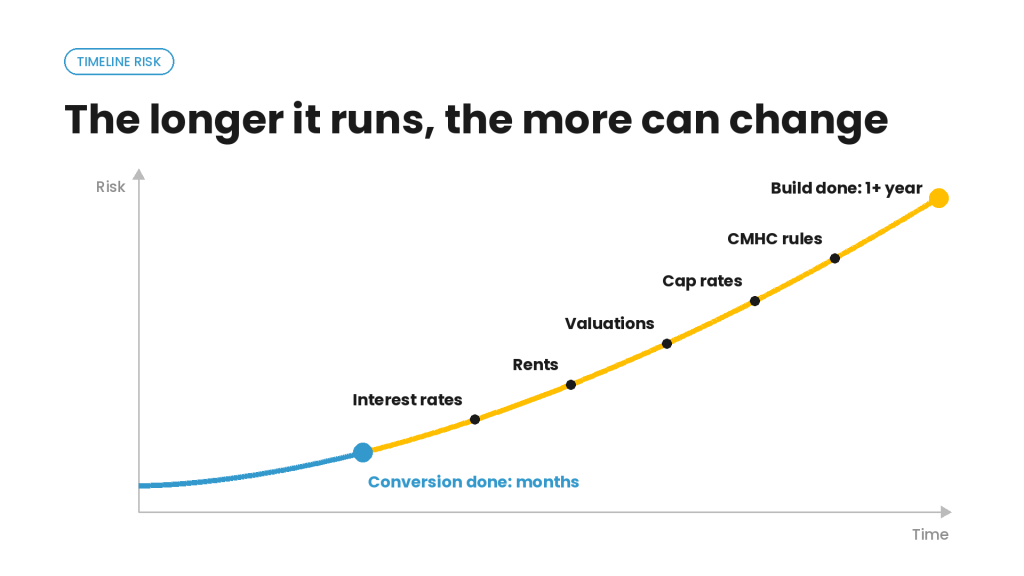
Time is the biggest risk in any build. A deal might look great on paper today. But a ground-up build can take a year or more, and a lot can change in that time. Interest rates can move. Rents can drop. Valuations and cap rates can shift. The longer a project drags on, the shakier the deal gets, and the longer it takes before you can do it again.
Rules are changing too. As more first-time builders step into this space, CMHC is getting stricter on construction financing, even for sixplexes. Insurance requirements are going up. Some projects now need bonded trades, which is a different and more expensive type of contractor. Or you hire a bondable general contractor, which also adds cost. On a smaller conversion, you can often use the same trusted trades you already know.
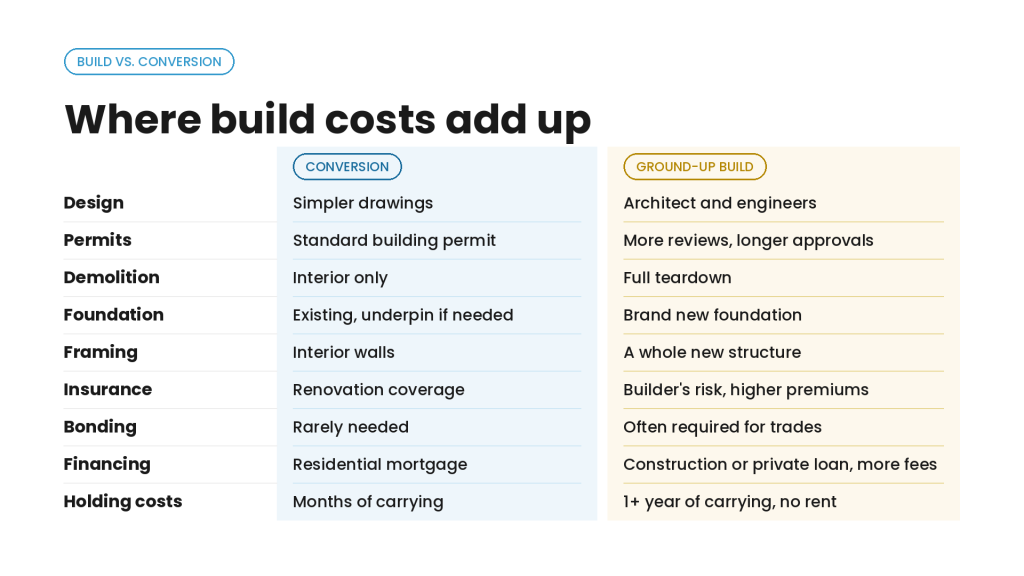
The costs of a build stack up in places a conversion avoids. Think full design with architects and engineers, longer approvals, full demolition, a new foundation, a whole new structure, and a year or more of holding costs with no rent coming in. Financing is often a construction or private loan with more fees, instead of a regular residential mortgage. We have seen clients go deep into the permit and financing process, then take an off-ramp before starting because the numbers changed. If you are thinking about a bigger project, read our guide to Toronto sixplex and multiplex rules first.
The Delta: How Much a Toronto Triplex Conversion Can Make
The delta is the gap between what you pay for a property and what it is worth after you renovate it. Right now, that gap can be very large in Toronto’s best neighbourhoods. In a slower market, people are more scared. And where there is fear, there is often opportunity.
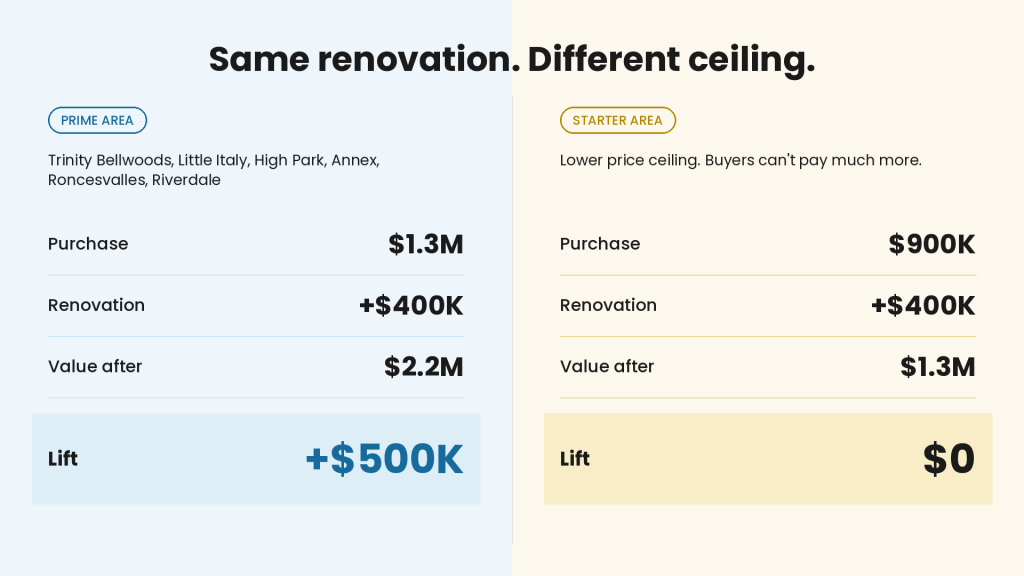
Here is an example our team is seeing. In prime areas like Trinity Bellwoods, Little Italy, High Park, the Annex, Roncesvalles and Riverdale, you can buy a house that needs a lot of work for about $1.3 million. Put in about $400,000 of renovations and you are all in at $1.7 million. Similar renovated homes nearby have sold for $2.2 million to $2.5 million in recent months. That is a lift of roughly $500,000 to $800,000, before closing and carrying costs. You can then sell, hold and rent it, or refinance to pull cash out and do it again. Use our total return calculator to test your own numbers.
Location is everything here. Do the same $400,000 renovation in a starter area and the math falls apart. Buy at $900,000, spend $400,000, and the finished home might only be worth $1.3 million. That is no lift at all. Buyers in those areas simply cannot pay much more, so the price ceiling is too low. Same renovation, very different result.
Exit Strategies and the Two to Three Unit Sweet Spot
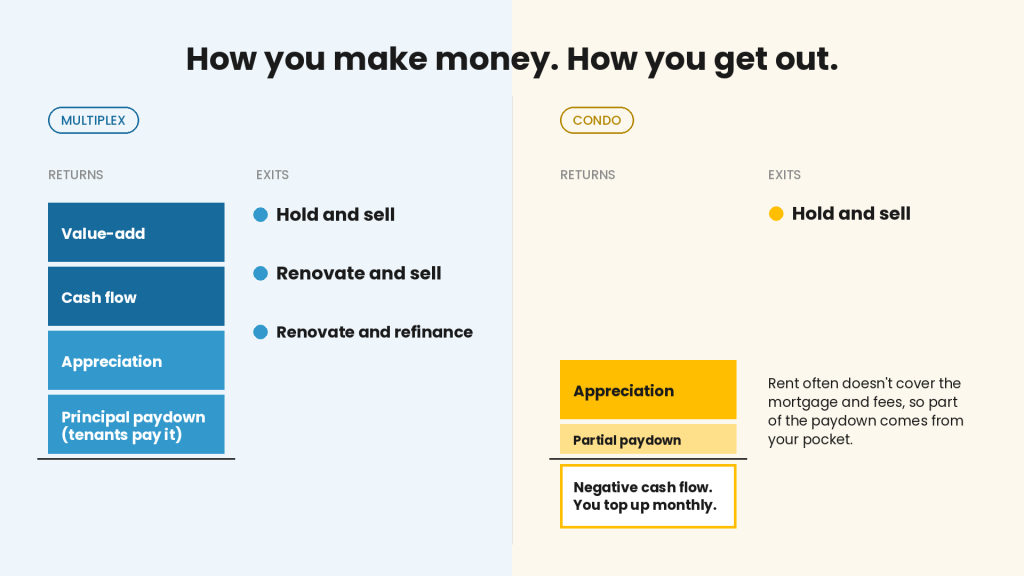
The last few years taught investors a hard lesson about exit strategies. Condo investors had one plan: prices go up, I make money. When prices went down, many had no other option. Rent often did not cover the mortgage and fees, so owners were paying out of pocket every month. When the property cannot carry itself and life changes, you can be forced to sell at the worst time.
A multiplex gives you more ways out. You can hold it and sell later. You can renovate and sell. Or you can renovate and refinance, pull your money out, and keep the property. The goal is simple: no matter what the market does, you should be able to hold on so you are never forced to sell. If your lot has room, you can also build a garden suite or laneway suite later. Think of it as banking that potential for when there is no better deal to buy.
So how many units should you aim for? A single-family home gets the highest resale value, but no rental income. Packing in as many small units as possible gets the most cash flow, but fewer buyers when you sell. Two to three units sits in the middle. A house with a basement apartment can sell for close to a single-family home, because the rent helps the next buyer qualify. If you go to three units, build it so it can be converted back without a big cost. That way you keep every exit open.
House Hack, Rent It All Out, or Buy Stocks Instead?
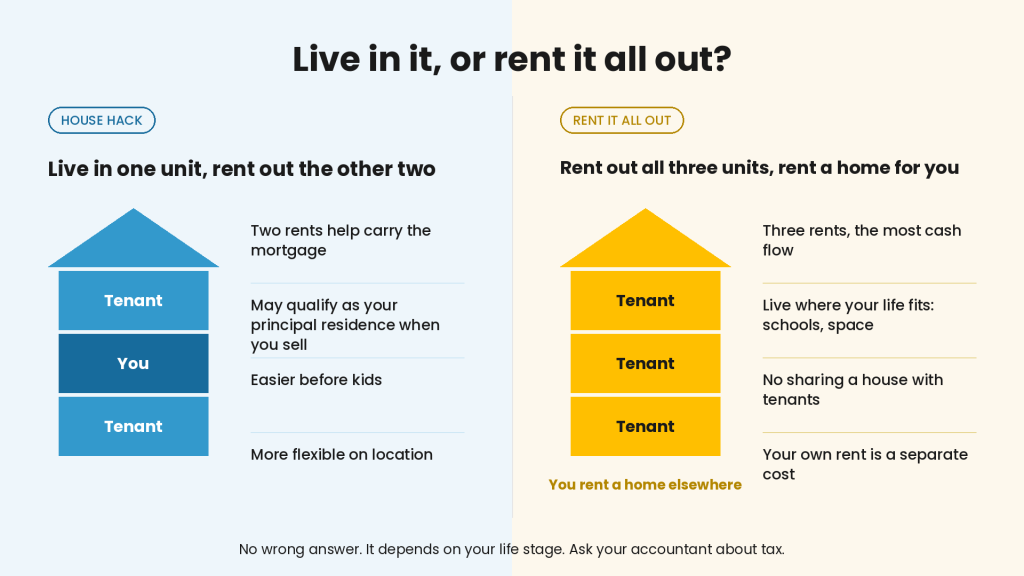
Two questions come up all the time. The first is whether to house hack or rent out the whole property. A house hack means you live in one unit and rent out the other two. The rent helps carry your mortgage, and the home may count as your principal residence when you sell, which can mean real tax savings. Talk to your accountant about how this applies to you. House hacking is often easier before kids and lets you be more flexible on location.
Renting out every unit is the other option. You get the most cash flow, and you live somewhere that fits your life, like a home near a good school with space for a growing family. You do not share a house with tenants, but you do pay your own rent. There is no wrong answer. It depends on your life stage, your comfort level and what you can afford. Few properties tick every personal box and every investment box, so be ready to compromise.
The second question is whether to put money into a multiplex or the stock market. Stocks have had a strong run, while Toronto prices have come down and rents have fallen less than prices, so the carrying math on a multiplex is better than it has been in years. A multiplex also lets you borrow more, often at lower rates than margin loans. You control the asset and can renovate to raise its value. And there are no margin calls, so a price drop does not force you to sell if you keep paying. The trade-off is that real estate takes longer to sell. Both can be good options. It depends on what you buy and where.
Find the Right Multiplex Strategy for Your Goals
Big builds get the headlines, but for most investors, a smaller Toronto multiplex conversion is still the stronger option. It is faster, less risky, and in the right neighbourhood, the delta can be huge. The catch is that the numbers only work when you pick the right location, plan the right unit mix, and keep more than one exit open.
That is where an experienced team makes the difference. Knowing which streets have the price ceiling to support a renovation, and which do not, can be the gap between a $500,000 lift and breaking even.
Our brokerage specializes in Toronto multiplexes. We’ll help you find deals, crunch the numbers, and guide you through renovations and management. If you want full support in Toronto multiplex investing, our team can help you:- Find high-potential properties
- Crunch the numbers so you know exactly where you stand
- Coach you through renovations to maximize returns
- Lock in great tenants
- Provide full property management so your investment runs smoothly

What Toronto Real Estate Investment Is Right For You?
Check out our complete Toronto real estate investment guide for all the details and real-life examples. If you’re ready to dive in, just book a call with us!
This is for educational purposes only; it does not guarantee future performance or serve as financial or tax advice.
