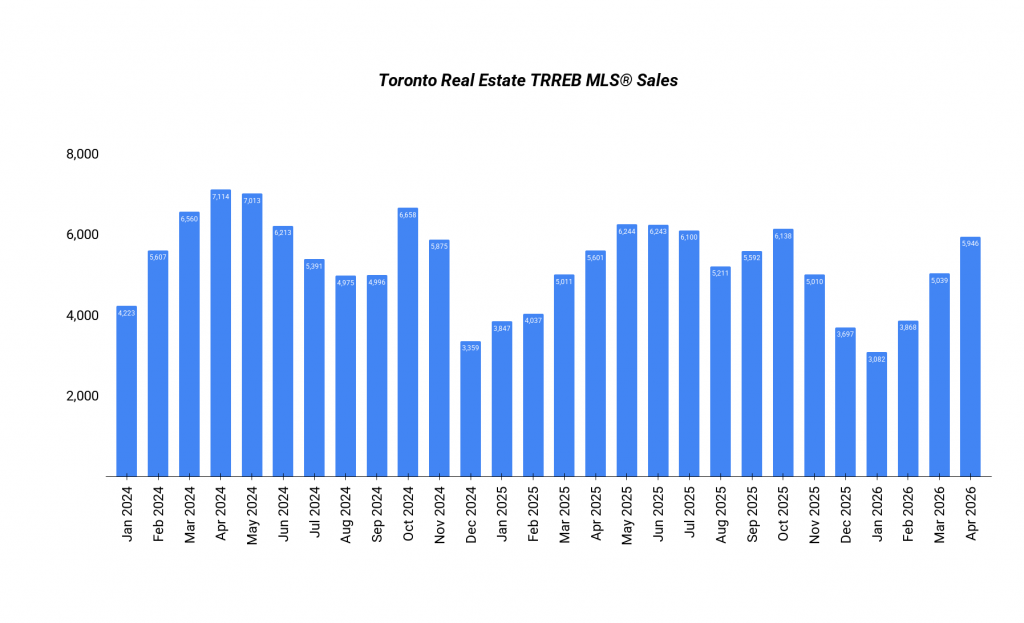
Q1 was slow across the board. A brutal winter, frozen buyer sentiment, and sellers holding firm on prices that no longer matched reality. But Q2 has been a different story entirely. Sales volume at Elevate is up 50% compared to the first quarter, and the deals coming through right now are some of the most compelling we’ve seen in years.
We sat down with Spiro, one of our lead agents, to break down what’s actually happening in the Toronto market this spring, where clients are finding real value, and what it takes to lock up properties at 30 to 40% below market value. If you’ve been waiting on the sidelines, this is worth reading carefully.
Toronto Is a Buyer’s Market, But Not Everywhere
The headline number is straightforward: Toronto real estate is in buyer’s market territory. Days on market are up, seller expectations have come down, and there’s more inventory to choose from than we’ve seen in several years. But averages can be misleading, and this is one of those markets where the averages hide more than they reveal.
The freehold market doesn’t behave like condos. Condo pricing tends to track averages fairly closely because the units are similar and comparable sales are plentiful. Freeholds are different. The value of a specific property depends heavily on its condition, its tenant situation, its lot size, and the block it’s on. Neighbourhood matters, but even within a neighbourhood, individual properties are telling completely different stories.
Pockets like Seaton Village, Trinity Bellwoods, and Little Italy are holding up much stronger than the citywide average suggests. Turnkey, vacant, move-in-ready properties in those areas are still drawing multiple offers and selling at or above asking. The buyer’s market advantage disappears quickly when you’re competing for the best product. Where the deals are concentrated is in a very specific category: tenanted properties with below-market rents that need significant renovation work. Those properties are sitting. Nobody wants them, which is exactly why they’re worth paying attention to.
How Clients Are Getting 30 to 40% Below Market Value
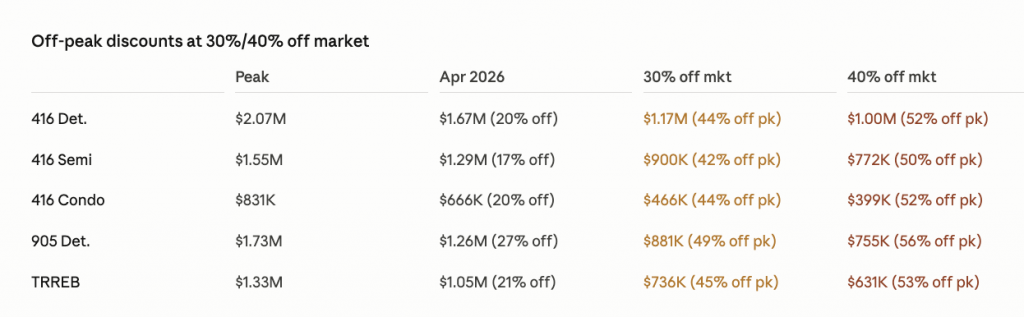
The discount Spiro’s clients are seeing right now isn’t off the asking price. It’s off the market value of a comparable property that’s fully renovated and vacant. That distinction matters. A property might be listed at $1.1 million with an asking price that already reflects some of its problems, but a fully finished comparable a few blocks away is trading at $1.4 million. The real delta is the gap between what you’re paying and what the finished product is worth, not what the seller originally hoped to get.
Recent deals have landed 20% below asking and 30 to 40% below the market value of comparable properties in finished condition. When you measure against peak pricing from a few years ago, some of these acquisitions are coming in at roughly half of what that same property would have sold for at the top of the market. That kind of pricing doesn’t happen on easy properties. It happens on the ones most buyers walk past: long-tenanted buildings with low rents, deferred maintenance, and sellers who are tired of managing them.
One deal that just firmed up is a good example. A semi-detached in the Little Portugal and Little Italy area, purchased for $1 million. A townhouse a few blocks south on a smaller lot sold for $1.38 million the week before. This property had a good lot size, ceiling heights around eight feet in the basement, a separate entrance, and is listed as a legal three-unit occupancy. It was tenanted at low rents, had been sitting on the market, and the seller simply didn’t want to deal with it anymore. That combination of factors is exactly what creates the opportunity. Another property currently under contract has a projected delta of $1 million to $1.2 million between the purchase price and what it could be worth post-renovation. That kind of spread is historically unusual, even for Toronto.
Why Negotiation Takes Months, Not Days
These aren’t quick transactions. One of Spiro’s recent deals took a month and a half of active negotiation before it firmed up. He showed the property ten to fifteen times during that period. The pace isn’t a weakness in the process. It’s actually part of what makes the deal work. Sellers on difficult properties need time to come to terms with where the market actually is. Rushing that process rarely produces the best outcome.
A lot of what drives results in negotiations like these comes down to the relationship between agents. When Spiro has an established connection with the listing agent, information flows more openly. He finds out more about the seller’s situation, their timeline, their motivations. That context shapes the offer strategy. It’s not about being aggressive or lowballing from the start. It’s about understanding what the other side actually needs and finding a structure that works. Sellers on tenanted renovation projects are often fatigued. They’re not looking to hold out for top dollar. They’re looking for a buyer who can close cleanly and take the problem off their hands.
The approach that works here is also the one that most buyers aren’t willing to take. Don’t anchor to the asking price. Send the property to your agent before you decide it’s out of reach or assume it’s priced fairly. The list price on a difficult property is rarely the right reference point. What matters is where it sits relative to the renovated comparable down the street, and how the numbers work once you’ve factored in the cost to get it there.
What Defensive Investing Actually Means
Spiro uses the phrase “defensive investing” constantly, and it’s worth unpacking clearly because it’s the filter that should shape every acquisition decision. Defensive investing doesn’t mean low risk in the conventional sense. It means buying into a position where the investment can absorb problems without requiring you to cover significant losses out of pocket every month.
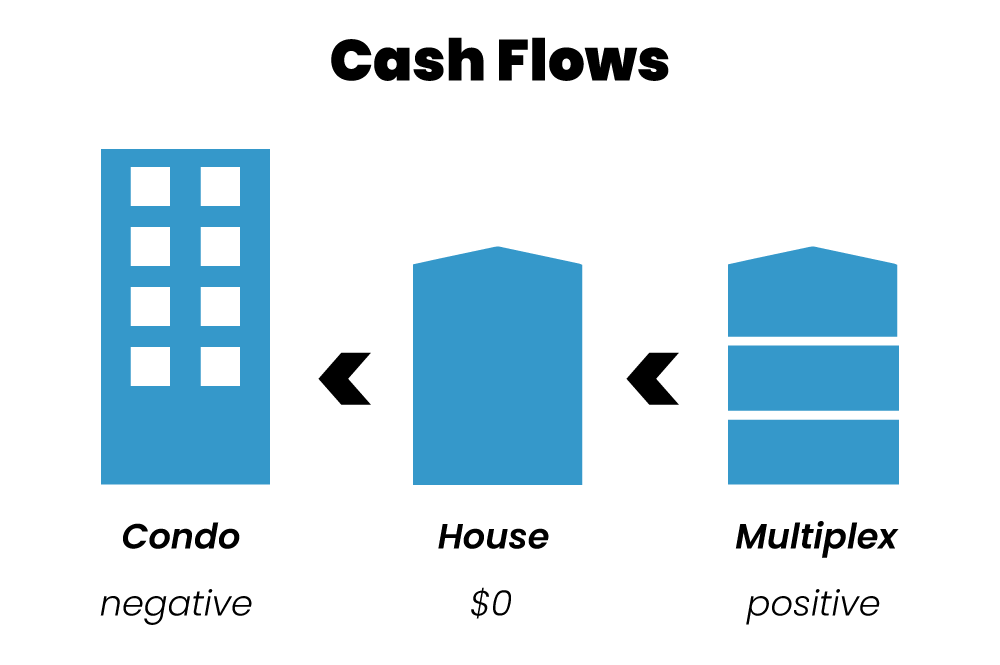
Think of an investment property as a business. Is it profitable from day one, or is it losing money? A property that requires you to top up $2,000 per month out of pocket before anything goes wrong is a property where any additional expense, a new roof, an appliance failure, a vacancy, hits you when you’re already underwater. A property that breaks even or runs a small positive cash flow gives you a buffer. When something goes wrong, and it will, you have room to absorb it. That’s the defensive position.
This is also why multiplex properties tend to be more defensively structured than single-family homes or condos. A well-purchased multiplex in Toronto, when the numbers are run honestly, can at minimum approach break-even and in many cases produce positive cash flow from the start. If a property is cash flow negative, that’s a signal worth examining. It may mean the purchase price is too high relative to the income the property generates. Use cash flow as a first filter, not the only filter, but a real one. If it doesn’t pass, dig in to understand why before you proceed.
You Don’t Have to Run the Project Yourself
The biggest obstacle most investors cite when it comes to renovation projects isn’t money. It’s time. Taking on a property that needs a major overhaul while working full time, managing other commitments, and potentially living somewhere else during the process is genuinely difficult. That friction has historically kept a lot of capable buyers away from the deals that offer the best returns.
The way Elevate has approached this has evolved. Historically, we connected clients with trusted contractors, handed them the playbook, and let them manage the project. That model still works for clients who want to be hands on. But we now work with crews that offer full white-glove service, meaning you don’t need to be on site, you don’t need to manage trades, and you don’t need to be in the same city. For investors who are busy and simply want the deal executed without the operational burden, that service layer is available. The cost is a bit higher, but for the right buyer, it unlocks deals that would otherwise be inaccessible.
If you’re an investor weighing a renovation project, the question isn’t really whether you have time. It’s whether the delta, the difference between the purchase price and the finished market value, is large enough to justify the cost of getting there, including a full-service crew if that’s what you need. On the right property, the answer is yes by a significant margin. The deals that exist in Toronto right now are the kinds of opportunities that come around when market conditions and seller fatigue align in a specific window. Use the total return calculator to run the numbers on any property you’re evaluating before you decide it’s too much work.
Ready to Find Your Next Toronto Multiplex Deal?
The spring market window that Spiro describes, sellers adjusting expectations, difficult properties sitting, and buyers with capital and the right team positioned to move, doesn’t stay open indefinitely. The deals that are getting locked up right now are the result of months of relationship-building, disciplined negotiation, and a clear framework for evaluating whether a property’s numbers actually work. Understanding defensive investing isn’t just a philosophy. It’s a practical tool for deciding which opportunities are worth pursuing and which ones carry more risk than the upside justifies.
Whether you’re evaluating your first multiplex or adding to an existing portfolio, the difference between a good deal and a great one often comes down to who’s in your corner and how deep they’re willing to go on the negotiation. That’s where the right team changes the outcome.
Our brokerage specializes in Toronto multiplexes. We’ll help you find deals, crunch the numbers, and guide you through renovations and management. If you want full support in Toronto multiplex investing, our team can help you:- Find high-potential properties
- Crunch the numbers so you know exactly where you stand
- Coach you through renovations to maximize returns
- Lock in great tenants
- Provide full property management so your investment runs smoothly

What Toronto Real Estate Investment Is Right For You?
Check out our complete Toronto real estate investment guide for all the details and real-life examples. If you’re ready to dive in, just book a call with us!
This is for educational purposes only; it does not guarantee future performance or serve as financial or tax advice.
