Most of the multiplex listings on the market right now are not good deals. We know because we look at hundreds of them every week, and only a small handful ever get an offer from us. So what do those deals have in common? It’s not the price, and it’s not always the rent.
Buying a home and buying a multiplex investment are two different things. What you’d look for in a house to live in is not what makes a good investment. In this post, we walk through what we actually check on every listing, using a real deal that looked like a pass on paper and turned into one of the strongest deals we’ve done this year.
A Deal That Looked Bad on Paper
We came across a listing on Caledonia Rd near Eglinton Ave that looked like a pass. It had been sitting on the market for over four months, it needed a lot of work, and the asking price was high for a house on a main road. If you were just scrolling listings online, you’d probably scroll right past it.
We went to see it anyway. That’s the part most people skip. You don’t actually know what a property is worth, or what the seller will actually take, until you walk through the house and put in an offer. Online, this was a bad deal. In person, we could see potential the photos weren’t showing. Once we got into negotiations, we found out what the seller was actually willing to accept, which was very different from the asking price.
The seller was asking around $1,000,000. Our clients picked it up for $785,000. Construction to convert it into three units came in around $200,000, so total capital, including a 20 percent downpayment and closing costs, landed around $380,000. Once it was done, the three units combined rented for $7,200 a month, bringing in over $3,000 a month in positive cash flow after the mortgage and operating expenses. Finished comps came in conservatively close to $1,200,000, a value-add lift of around $200,000. After a refinance, our clients pulled out around $300,000, roughly 84 percent of their initial capital, leaving just $60,000 in the deal and still cash flowing over $1,000 a month.
The Five Things We Check on Every Listing
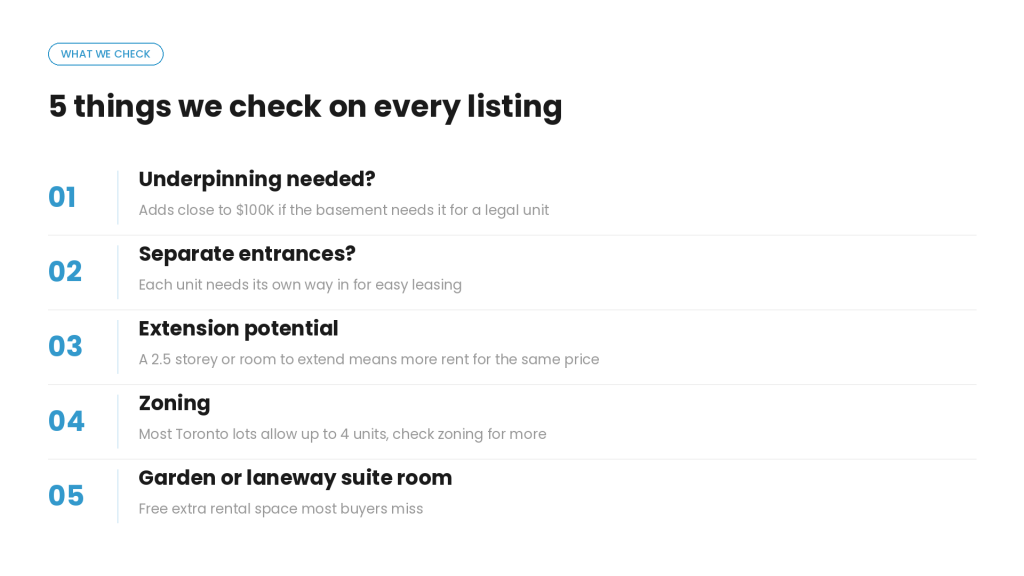
Once we’re standing in a house, here’s what we’re actually looking for. First, can the main house support a proper basement unit, or does it need underpinning to get there. That single answer can add close to $100,000 to your renovation, so it’s the first thing we check.
Second, can each unit get its own separate entrance. Third, the actual size of the house. Two houses can list at the same price, but a bigger house, something like a 2.5 storey or an existing extension at the back, gives you more space for more rent. That’s a great value buy hiding in plain sight.
Fourth, zoning. Most lots in Toronto allow at least four units, but if you’re looking for more, you’ll need to check zoning for that. You can read more in our guide on Toronto sixplex and multiplex rules. Fifth, the backyard and side yard setbacks, for garden suite or laneway suite potential. That’s one of the biggest value questions you can ask, because it’s basically asking if there’s free space to build another rental unit that most investors aren’t even considering.
Running the Real Numbers
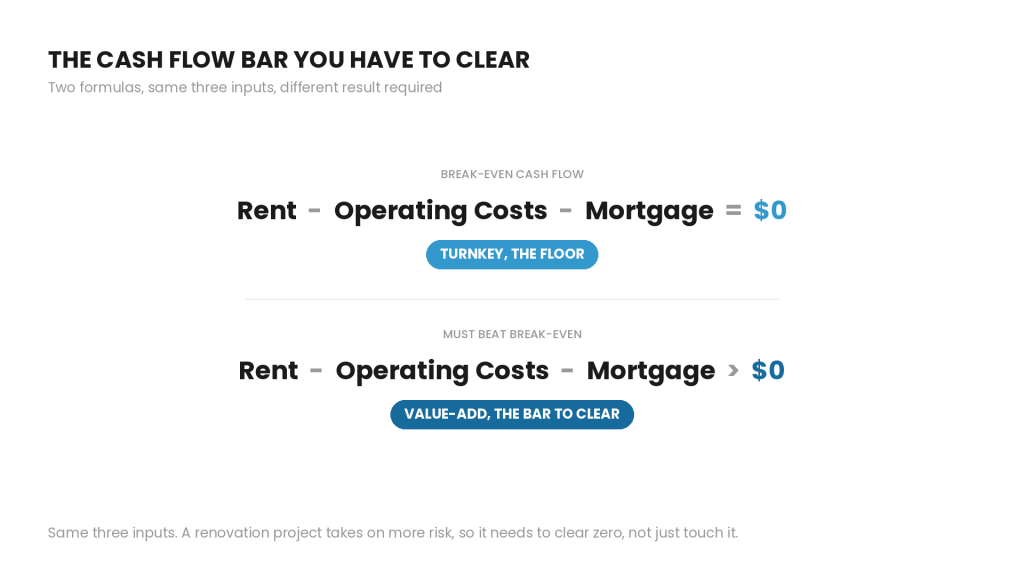
Once a property clears those checks, we run the real numbers. Purchase price plus renovation cost against expected rents. Our bar is simple. A turnkey multiplex in Toronto should at least break even, so a renovation project needs to beat that, because you’re taking on renovation risk a turnkey buyer isn’t. You can read more about how we think about this in our guide to cap rates in real estate.
The formula behind break-even cash flow is simple. Rent, minus operating costs, minus your mortgage payment, should be zero or better for a turnkey property. For a value-add project, that same number needs to be clearly above zero, not just touching it, to make the extra risk worth it.
This is also where a lot of investors miss the bigger opportunity. The best deal isn’t always the one with the highest monthly cash flow. Sometimes a deal has slightly lower cash flow but a much bigger value-add lift, meaning the finished value comes in way higher than what you put into it.
Cash Flow vs Value-Add Lift
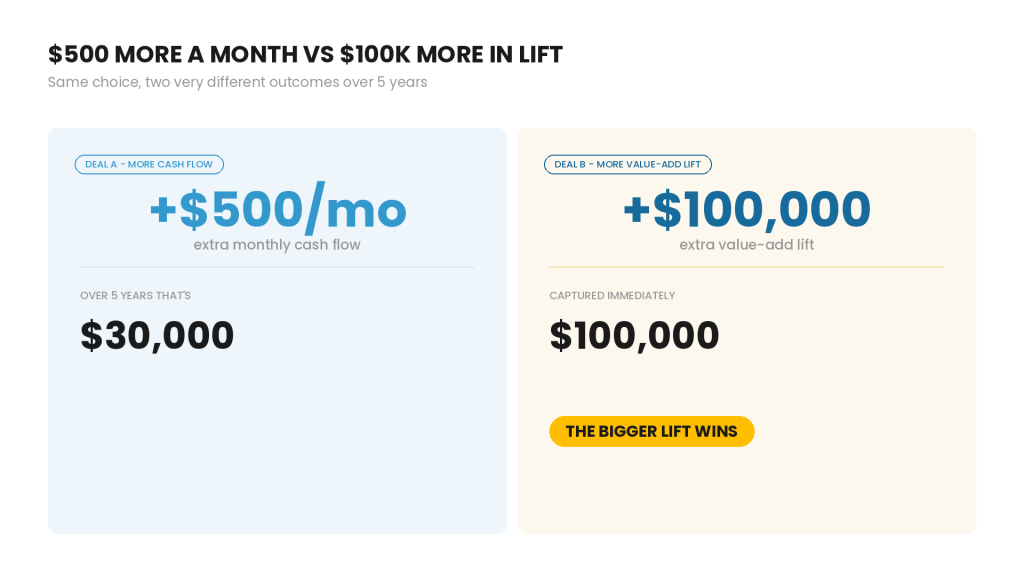
We’ve seen investors chase an extra $500 a month in rent and walk past a deal with $100,000 more in value-add lift. Over five years, that extra $500 a month barely adds up to $30,000. The bigger lift wins almost every time, like it did on Caledonia.
Neither approach is wrong, and which one is right for you usually comes down to where you are in your investing journey. Newer investors tend to lean toward cash flow, because stronger cash flow helps you qualify for more mortgages, especially when your income is still on the lower side.
As your income grows and you get a few deals under your belt, most investors pivot toward value-add, since that’s usually the better path to maximizing your overall return. If you want to see how this plays out over time, our total return calculator is a good place to start.
Starter Areas vs Mature Areas
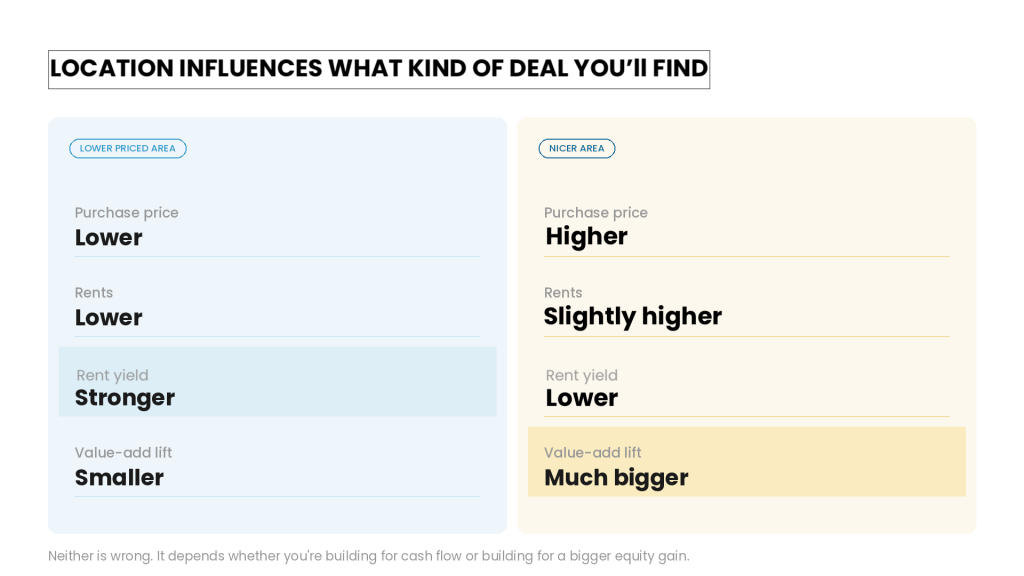
Location changes the kind of deal you’ll find too. In starter areas, prices are lower, and so is the renovated value ceiling. You’ll usually get stronger monthly cash flow but a smaller lift.
In mature areas, cash flow often looks similar to a starter area, just on a much bigger purchase price, with a much bigger lift once the renovation is done. Neither is wrong. It depends whether you’re building for monthly income or building for a bigger equity gain.
The next time you see a listing that’s been sitting for a while, needs work, and is priced high, don’t scroll past it. Go see it. Run the numbers. Find out what the seller will actually accept. That’s how a deal that looks bad on paper can turn into one of the best ones you’ll do all year.
Work With a Team That Does This Every Week
You can absolutely run this process on your own. But we’ve looked at hundreds of listings and made the mistakes already, the ones that are expensive to learn on your own. Deals like Caledonia don’t happen by chance. They happen because we check the same five things on every listing, then run the numbers before deciding whether it’s worth the risk.
Our brokerage specializes in Toronto multiplexes. We’ll help you find deals, crunch the numbers, and guide you through renovations and management. If you want full support in Toronto multiplex investing, our team can help you:- Find high-potential properties
- Crunch the numbers so you know exactly where you stand
- Coach you through renovations to maximize returns
- Lock in great tenants
- Provide full property management so your investment runs smoothly

What Toronto Real Estate Investment Is Right For You?
Check out our complete Toronto real estate investment guide for all the details and real-life examples. If you’re ready to dive in, just book a call with us!
This is for educational purposes only; it does not guarantee future performance or serve as financial or tax advice.
