Say you’re choosing between two Toronto neighbourhoods for your next multiplex. One has grown at two and a half percent a year over the last 10 years. That is decent, given that prices have already dropped 25 percent. But the other neighbourhood grew at double that rate, and that gap makes a huge difference to your return.
We pulled the numbers straight from TRREB’s Home Price Index report for July 2026 and looked at two storey detached homes across different Toronto neighbourhoods. Here is what 10 years of real data shows about where growth actually happened, and what that means if you are planning your next multiplex investment.
What the Data Shows: 10 Years of Toronto Growth
Toronto is a diverse city. Two homes only ten minutes apart can follow completely different price trends. That matters a lot when you are deciding where to put your money.
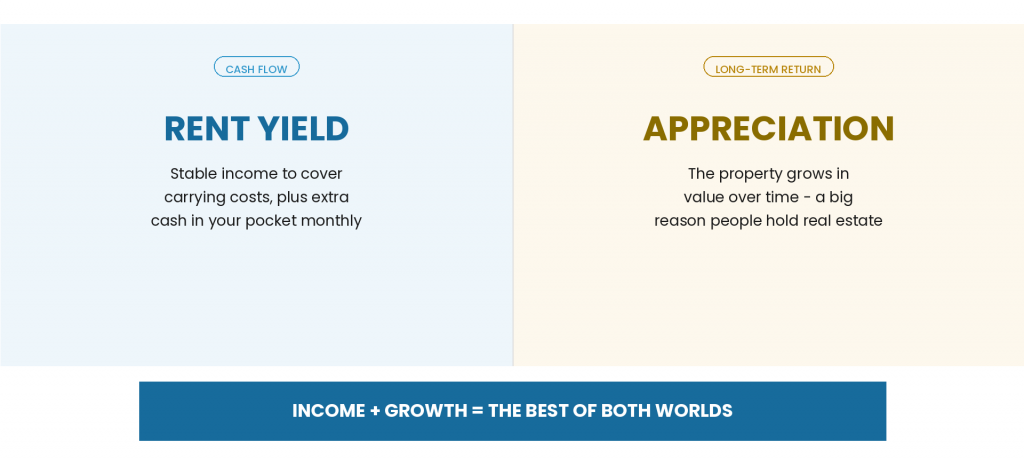
We looked at three things for each neighbourhood. First, long term appreciation over the full 10 years. Second, how steep the drop was during the recent correction. Third, which areas managed to combine strong growth with a shallower fall than the rest of the city.
This gives a clearer picture than just looking at today’s prices. A neighbourhood that grew steadily and held up better during the correction is a very different investment than one that spiked and then gave it all back.
The Winners: High Park, Junction, and the West End
High Park and Junction led the city, growing close to 58 percent over ten years. That is even after prices dropped about 25 percent during the recent correction. Notice that the top spots all sit along the same stretch of west end Toronto.
Past that cluster, Oakwood-Vaughan also did well. In the east end, South Riverdale and East End-Danforth rounded out the top spots.
Here is the part worth noticing. These are not always the most expensive or fanciest areas in the city. Many of these neighbourhoods are solid, walkable, and sit close to the one million dollar mark. Toronto’s strongest growth did not come from buying the priciest postal code. If you are investing, do not ask “would I live here.” Ask where the numbers are best.
The Weakest Growth: North York
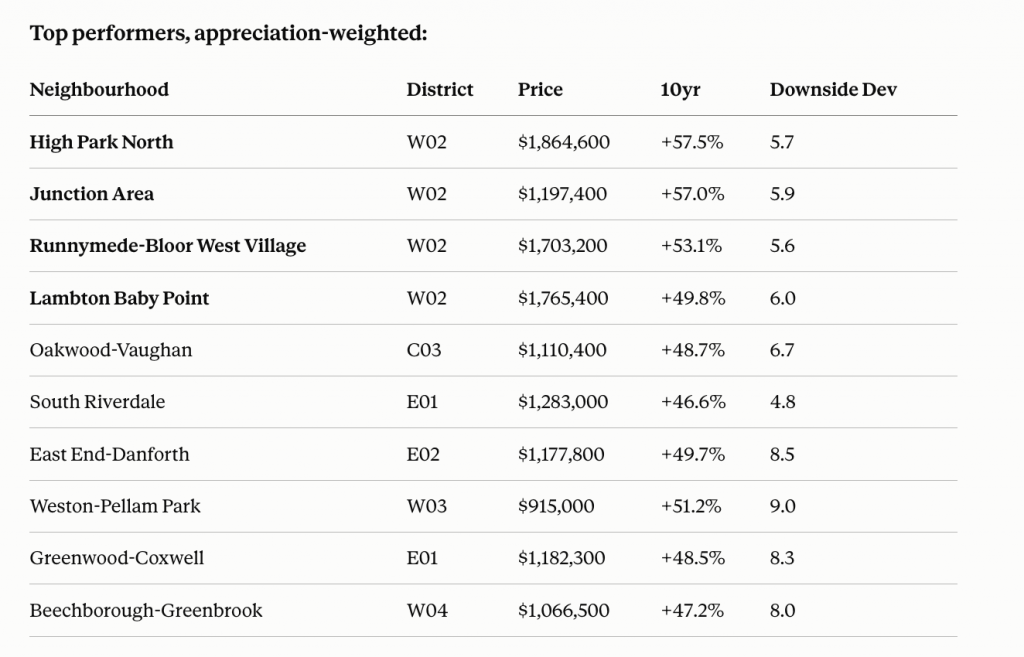
Now flip it around. The weakest growth in the whole city over the last 10 years was in North York. Those areas barely moved at all.
That does not mean these are bad places to live. It might even be where you live now, or where you want to move one day. Livability and investment growth are two different questions.
But if appreciation is your main goal as an investor, the data says to look elsewhere first. A neighbourhood can be a great place to raise a family and still be a weak choice for growth focused investing.
Why Rent Yield Still Matters
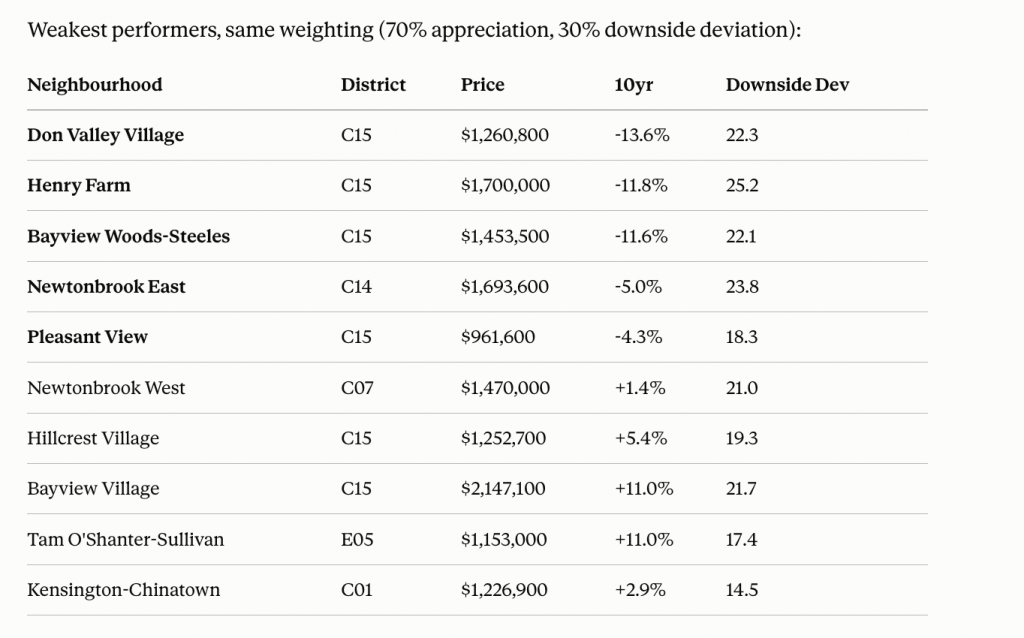
Strong rent yield is still key to a good multiplex investment. It gives you stable income to cover your carrying costs, plus extra cash in your pocket every month.
But appreciation is still a big part of the returns equation. It is a huge reason people hold real estate in the first place, since the property grows in value over time. When you combine strong rent yield with strong appreciation, you get the best of both worlds: income and growth.
The west end Junction and Oakwood areas, plus the east end Danforth pockets, tend to have both. Rents do not change much between neighbourhoods, often only 10 to 20 percent. But prices can be 50 percent cheaper or more in one area versus another. That means cheaper areas often give you a better rent yield, and usually more room left to grow too, since they are earlier in the gentrification process.
Growth Areas vs Premium Areas: Two Different Strategies
If your goal is renovation and value-add, the math changes. Premium areas like High Park or Riverdale often make more sense for this strategy.
There is a bigger gap between what you pay for the property and what the finished product is worth, since these areas can support higher prices. That means the same renovation gives you a bigger lift in a premium area than it would somewhere cheaper.
This is why the right neighbourhood depends on your strategy, not just the growth numbers on their own. A cheaper, emerging area can be the better choice for rent yield and long term appreciation. A premium area can be the better choice if you plan to create a multiplex and add value through renovation. You can run your own numbers on either approach with our total return calculator.
Which Toronto Neighbourhood Fits Your Strategy?
Growth is not random. It follows the numbers, not the postal code. Whether you are chasing rent yield, long term appreciation, or a renovation lift, the right Toronto neighbourhood depends on what you are actually trying to achieve.
Picking the right pocket of the city takes more than looking at last year’s prices. It takes a full 10 year view, an honest look at your goals, and someone who knows which areas back up the numbers.
Our brokerage specializes in Toronto multiplexes. We’ll help you find deals, crunch the numbers, and guide you through renovations and management. If you want full support in Toronto multiplex investing, our team can help you:- Find high-potential properties
- Crunch the numbers so you know exactly where you stand
- Coach you through renovations to maximize returns
- Lock in great tenants
- Provide full property management so your investment runs smoothly

What Toronto Real Estate Investment Is Right For You?
Check out our complete Toronto real estate investment guide for all the details and real-life examples. If you’re ready to dive in, just book a call with us!
This is for educational purposes only; it does not guarantee future performance or serve as financial or tax advice.
