CMHC will lend you up to 95 percent of build costs on an MLI Select project. On paper, that sounds like the smartest way to grow a Toronto real estate portfolio. But when we ran the real numbers on a triplex conversion against a ground up MLI Select build, the math told a very different story than the pitch does.
Both paths grow your portfolio. They are not the same bet. Below, we compare capital, financing, timelines, cash flow, value-add, and exit across both strategies, using real deal numbers, so you can see which one actually fits your capital and your risk tolerance.
The Capital and Financing Gap
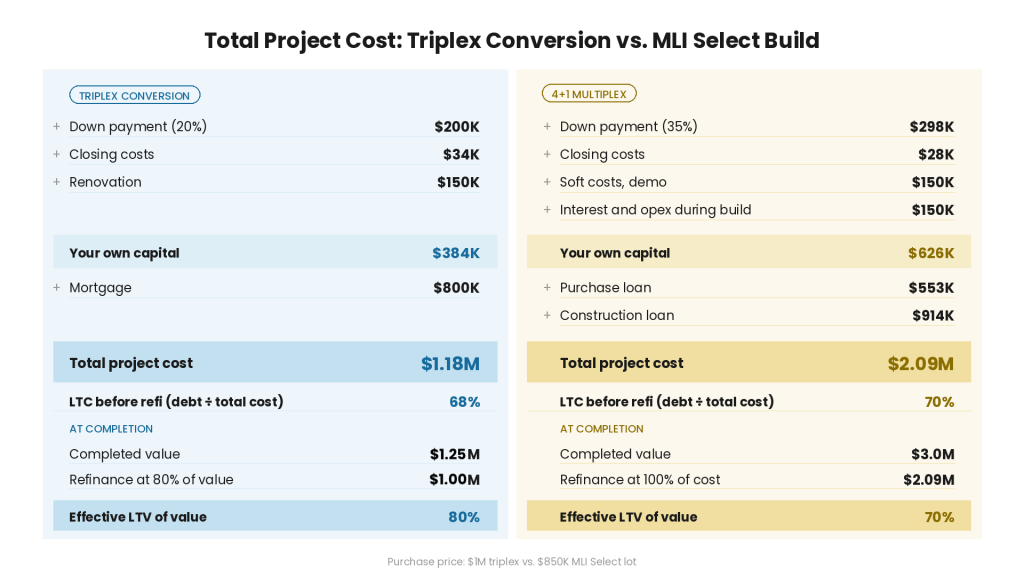
A triplex conversion in Toronto usually costs around one million dollars all in. Put 20 percent down, add closing costs and a renovation budget, and most investors need around 400,000 dollars of their own cash, carrying about 800,000 dollars in debt.
An MLI Select build is a different scale. You put 35 percent down on the purchase, then finance soft costs, holding costs, and demolition on top. Total capital required often lands near 600,000 dollars, with debt closer to 1.45 million dollars. That is a lot more exposure if anything goes sideways, and construction projects go sideways more often than people plan for.
CMHC’s 95 percent of cost financing sounds generous, but it is not the same as 95 percent of finished value. Once you work through how these projects get valued, most investors are really only unlocking around two thirds of the finished value in financing. A triplex, by comparison, can often be refinanced at 80 percent of value. Read more about how creating a multiplex in Toronto actually works before comparing the two paths.
Cash Flow and Cap Rates: The Surprising Split
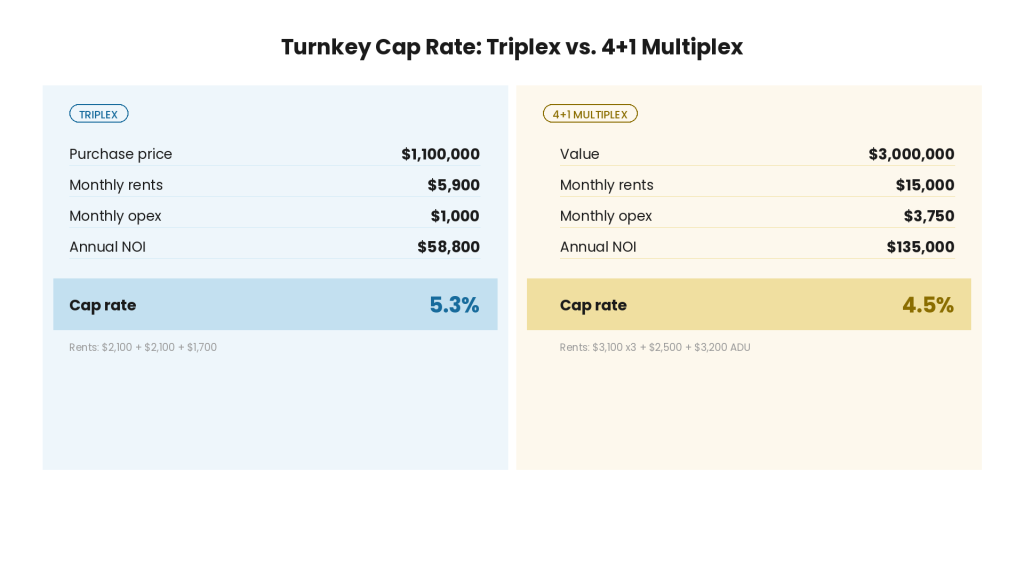
Smaller multiplexes like triplexes tend to earn a stronger cash flow return in Toronto, often landing turnkey cap rates in the 5 percent range depending on the neighbourhood. Larger multiplex builds usually land lower on a stabilized basis, closer to 4.5 percent. Learn more about how cap rates in real estate actually work and why they matter for comparing deals.
That means the smaller, cheaper property can out earn the big multiplex build on a pure income basis. It is the opposite of what most new investors assume walking in, since the bigger asset feels like it should perform better simply because it is bigger.
Time matters just as much as the return itself. A triplex conversion usually takes 3 to 6 months. An MLI Select build can take a full year or longer before a single tenant moves in. That is a year of holding costs, a year of construction risk, and a year where the property earns nothing.
Exit and Liquidity: Where the Two Paths Really Split
A triplex can be refinanced or sold to a large pool of buyers. That includes other investors, but also everyday house hackers, like a couple or a young family who want to live in one unit and rent out the rest to help cover their mortgage. More buyers means an easier, more liquid market when it is time to sell.
A finished 4 plus 1 or 6plex is a much bigger asset. Almost nobody house hacks a building that size, so the buyer pool shrinks fast. That makes it a harder property to move when you actually need to sell or refinance.
If you are weighing a larger build, it is worth understanding Toronto’s sixplex and multiplex rules in detail first, since zoning and unit count directly affect both your financing options and your eventual buyer pool.
The Value-Add Payoff, and Where It Can Go Wrong
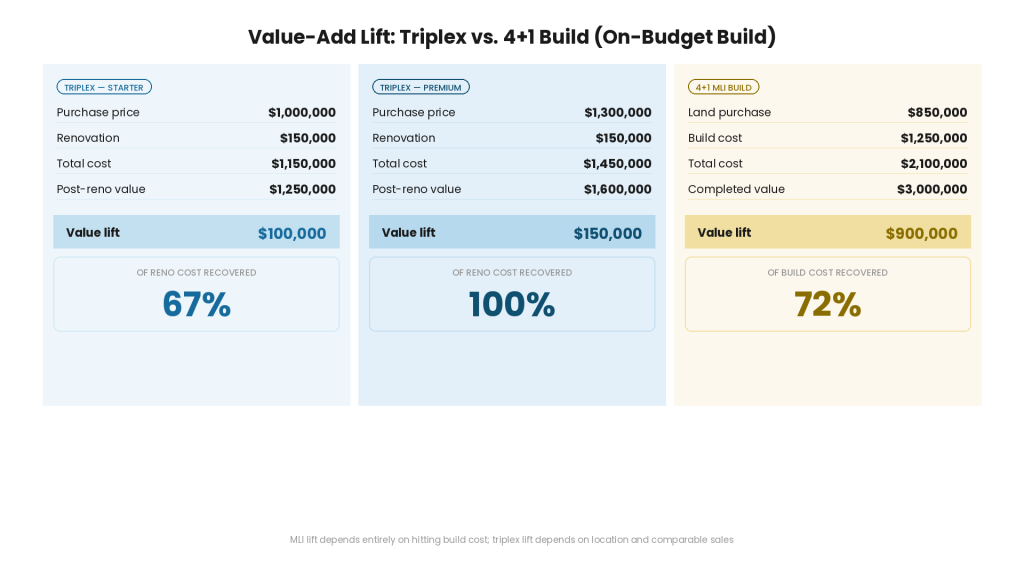
For a triplex, the value lift comes from location and what similar renovated homes are actually selling for, not from any income formula. Starter neighbourhoods might see a lift of 100,000 to 150,000 dollars after renovation. Premium areas can recover close to 100 percent of the renovation cost. A good target is getting back at least two thirds of your renovation cost within about six months.
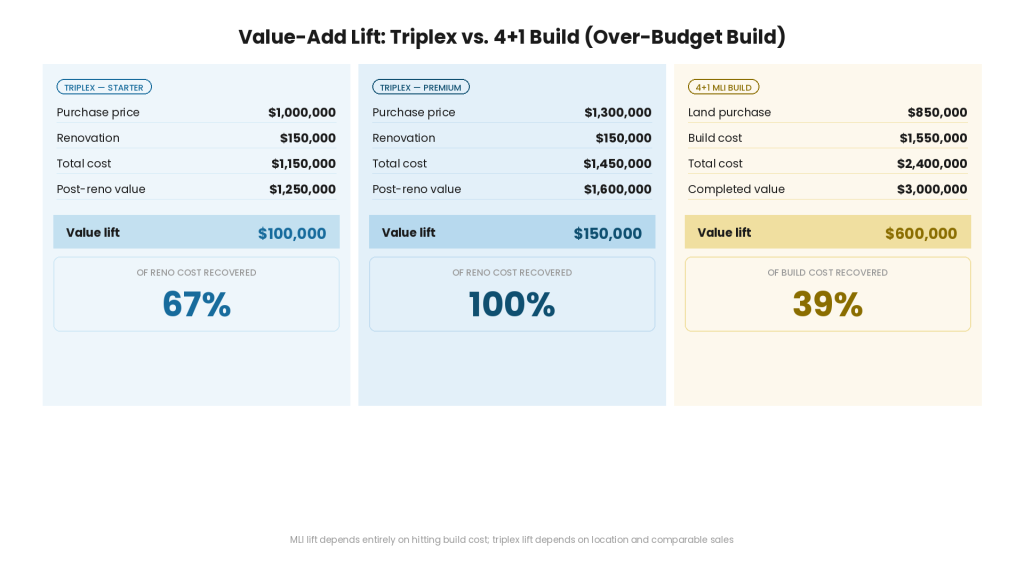
For an MLI Select build, the payoff depends entirely on how tightly you control construction costs. If a builder buys land for 850,000 dollars and builds for 1.25 million, a completed building trading near 3 million dollars in value can return roughly 72 percent of the build cost. But if build costs creep higher, that return can fall to under 40 percent for the exact same completed value.
That swing is the real risk in a ground up build. The numbers only work if you are a builder who can control costs and hit your timeline. For most everyday investors, that level of construction risk is a lot to take on for a similar, or sometimes worse, result than a much simpler renovation.
Which Path Actually Pencils for You
For most everyday investors, the triplex conversion wins. It needs less time, less capital, less debt, and it can match or beat a large multiplex build’s return without needing construction experience. An MLI Select build really only makes sense for experienced builders who need CMHC financing to scale across many projects and can reliably hit their costs and timelines.
Our brokerage specializes in Toronto multiplexes. We’ll help you find deals, crunch the numbers, and guide you through renovations and management. If you want full support in Toronto multiplex investing, our team can help you:
- Find high-potential properties
- Crunch the numbers so you know exactly where you stand
- Coach you through renovations to maximize returns
- Lock in great tenants
- Provide full property management so your investment runs smoothly

What Toronto Real Estate Investment Is Right For You?
Check out our complete Toronto real estate investment guide for all the details and real-life examples. If you’re ready to dive in, just book a call with us!
This is for educational purposes only; it does not guarantee future performance or serve as financial or tax advice.
