A client of Sheryl’s just bought a three-storey detached home in Prime Annex for $1.34 million. The direct neighbour — same lot size, same building footprint — sold for $2.6 million a few years back. That gap of over $700,000 is not a mistake. It’s the opportunity.
The house already had two units. There’s a detached garage at the back that can be converted into a laneway suite. By converting the main house into a triplex and building out the laneway, the plan brings total rent to around $13,000 a month. Once the dust settles, the investor has a choice: hold for $6,000 a month in pure cash flow, or refinance and pull out more than he put in to fund the next acquisition. This is exactly the kind of deal that makes Toronto multiplex investing worth paying attention to right now.
The Deal Breakdown — What Was Actually Bought
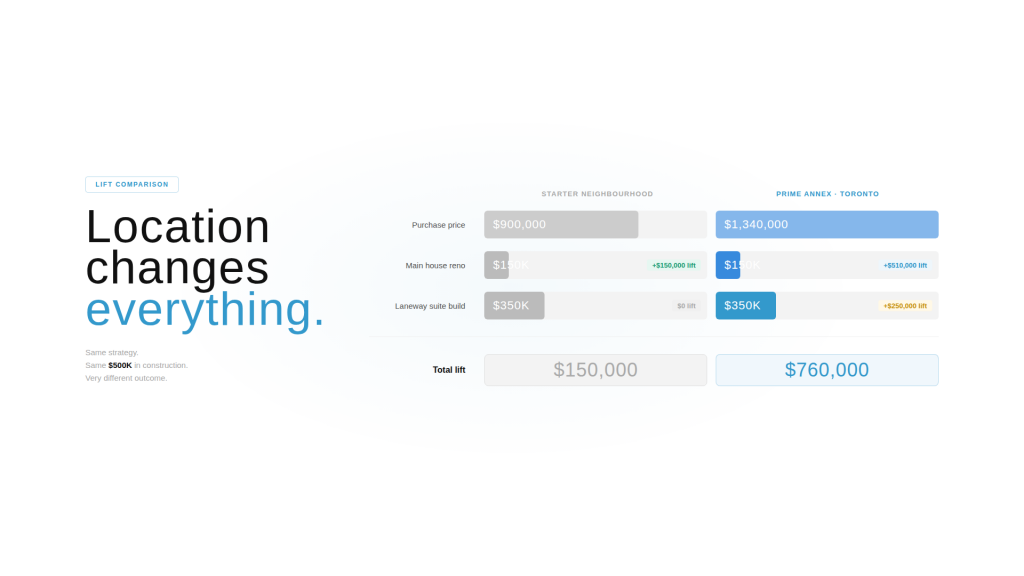
The property is a three-storey detached home in the Annex, one of Toronto’s most desirable and transit-connected neighbourhoods. It came with two existing units and a detached garage at the rear. Purchase price: $1.34 million. The neighbour’s equivalent home sold for $2.6 million — and that property didn’t even include a laneway suite.
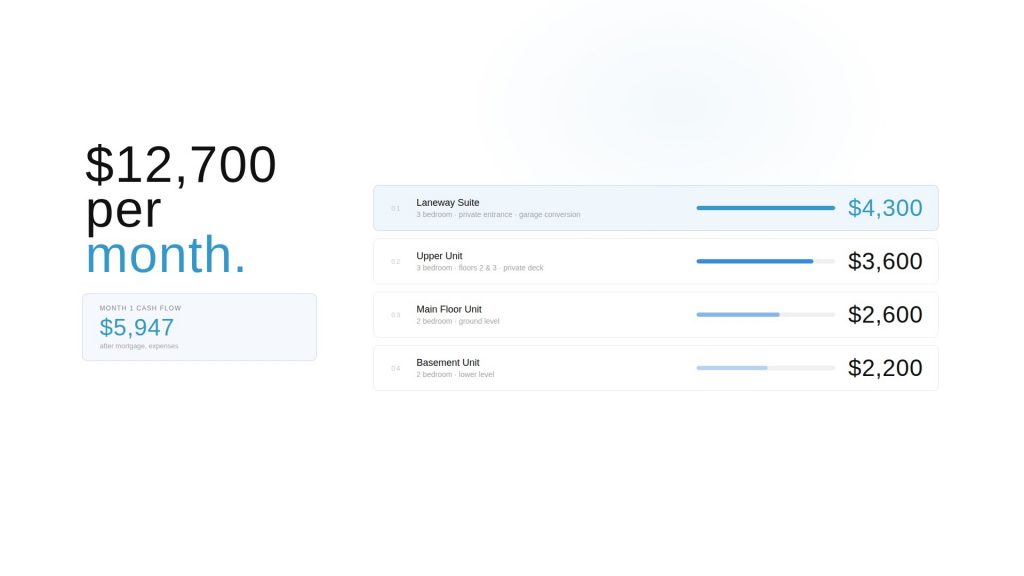
The plan is to convert the existing two-unit house into a triplex by adding a legal basement unit, and to build a separate three-bedroom laneway suite using the existing garage structure as a base. This creates four rentable units in total: a main-floor two-bedroom, a basement two-bedroom, a second-and-third-floor three-bedroom with a private deck, and a detached three-bedroom laneway suite.
Combined, those four units are projected to bring in close to $13,000 a month. The laneway suite alone is expected to rent for $4,300 to $4,400 per month. The main-floor unit will bring roughly $2,600, the basement unit around $2,200, and the upper unit approximately $3,600 to $3,700. That’s not a projection built on optimism — it’s based on current rents in the immediate area for units of that size and quality.
Construction Costs and Why Location Changes the Math
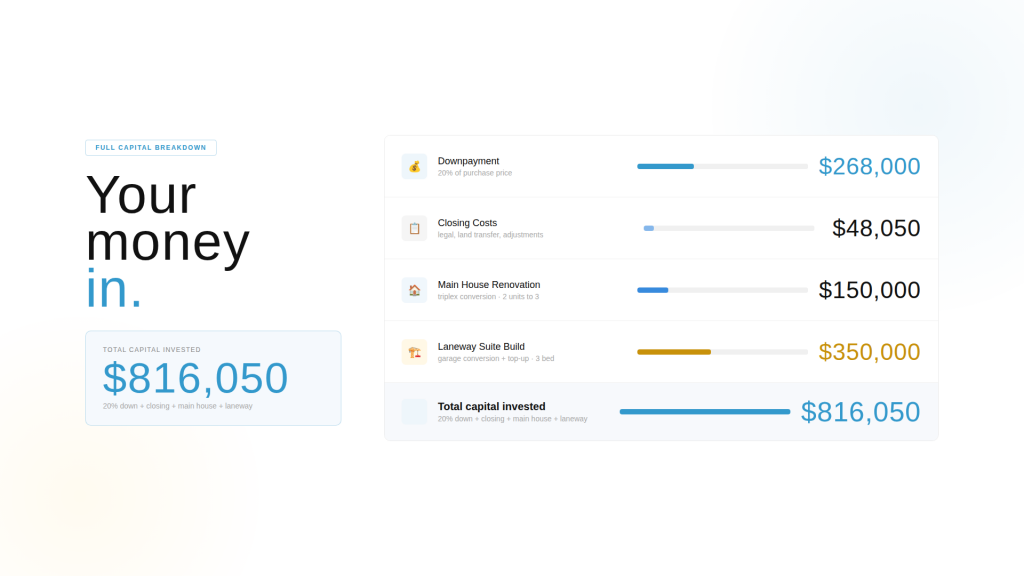
The renovation budget for the main house comes in at around $150,000. That covers finishing the basement suite and bringing the rest of the building up to code. The laneway suite is a bigger lift — estimated at $350,000 — though the investor is managing the project himself and plans to reuse existing structure and foundation where possible, which could bring that number down.
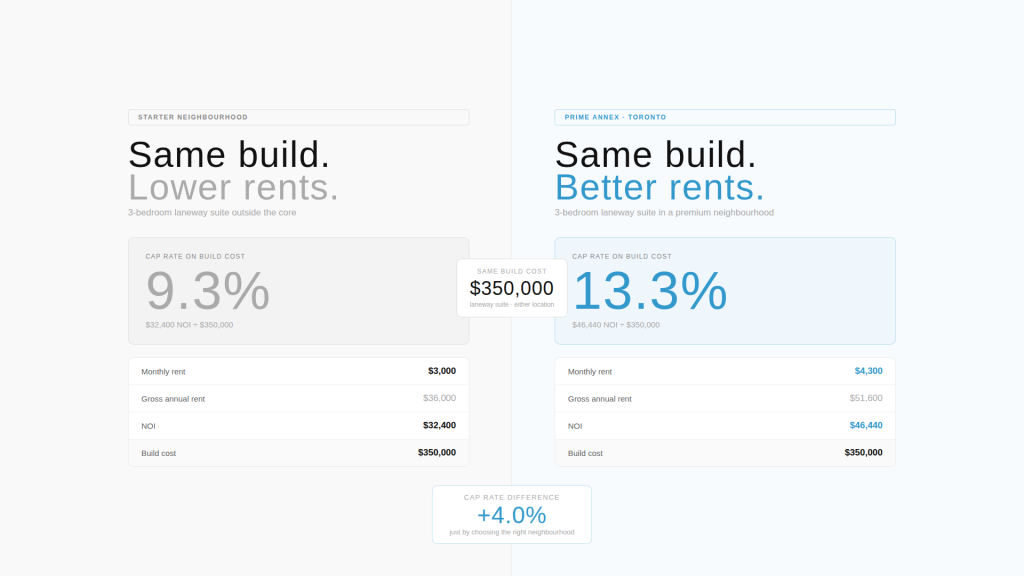
You can build a laneway suite in a starter neighbourhood for the same $300,000 to $350,000. But you won’t get the same rents, and the numbers won’t work as well. In a prime, transit-connected location like the Annex, you’re collecting significantly higher rent for the same construction cost. That directly improves your cap rate. It also means the laneway suite adds more value to the overall property — both as a rental income stream and as a valuation lift when comparable sales are used to assess the property.
The main house gets its own value lift through the triplex conversion, and the laneway suite adds a second layer on top of that. Properties with laneway suites are increasingly showing up in sold comparables with measurable price premiums. In a neighbourhood where the baseline comp is already $2.6 million — without a laneway — the ceiling here is meaningfully higher. To understand how these numbers compound into total returns, it helps to model them out using a tool like the total return calculator.
The BRRRR Strategy and How This Deal Fits It
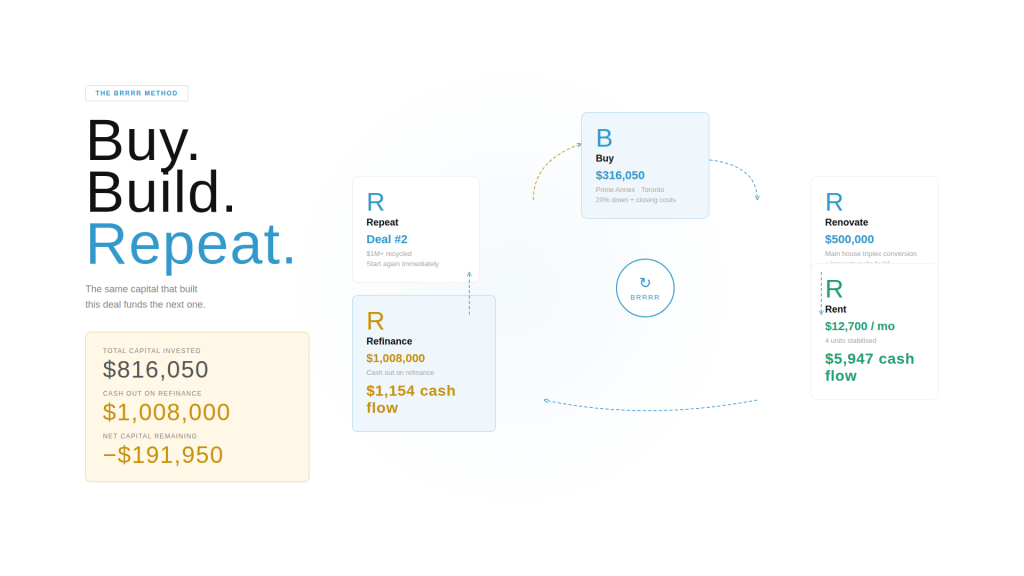
Once the project is complete and the units are rented, the investor has two clear paths. The first is to hold. After covering the mortgage, interest, insurance, and utilities, the projected cash flow lands around $6,000 a month. That’s a real number in a prime Toronto neighbourhood, built on four legal rental units with strong tenant demand.
The second path is to refinance. Using the neighbour’s $2.6 million sale as a conservative comparable — and that property doesn’t even have a laneway suite — the investor can pull out all the equity he put into the project and then some. That capital goes directly into the next acquisition. He hasn’t depleted his equity position. He’s reset it and reloaded it.
This is the BRRRR model: Buy, Renovate, Rent, Refinance, Repeat. What makes this deal particularly well-suited to it is the gap between the purchase price and the completion value. That gap simply doesn’t exist in the same way in starter neighbourhoods. If you buy at $900,000 and the finished property is worth $1.2 million, it’s very hard to pull out all your capital and still have a functioning mortgage. In Prime Annex, with the right renovation scope, you can get all your money back and still have a property that cash flows. That’s the snowball effect in practice.
How Sheryl Locked It Up
The headlines say Toronto real estate is soft. The reality on the ground for a good deal in a desirable neighbourhood is different. Investors are looking at cap rates. Families are looking for a home to raise their kids in a neighbourhood with good transit and schools. Both groups want the same properties, and the overlap drives competition even in a buyers market.
The way Sheryl worked with her client was to understand his risk profile first. He was comfortable with construction. He wasn’t afraid of the unknowns that come with building a laneway suite from scratch. He wanted the best deal possible, even if that meant more work. Once Sheryl understood that, she knew exactly what to look for and moved the moment this property hit the market. They were there within two hours of the listing going live. An offer went in immediately.
They had made bids before and lost because they moved too slowly. The client saw firsthand what it cost to hesitate. Acting fast doesn’t mean acting blind, though. The offer included a financing condition and an inspection condition. Within three business days, a contractor went in to provide an estimate, and an architect completed a feasibility study for the laneway suite. Once everything came back within range, they firmed up. The key difference between this market and the peak sellers market is that you can still move fast and still protect yourself with conditions. Sellers are far more willing to accept conditional offers now than they were two or three years ago.
Who This Deal Works For — and Who It Doesn’t
This deal is genuinely exciting on paper. Most people who hear the numbers want in immediately. But the construction timeline is around 10 months of active work. Building a laneway suite involves real unknowns — permit timelines, structural surprises, contractor coordination. Managing a renovation of this scope takes skill, time, and a high tolerance for uncertainty. It is not passive income during the build phase.
That’s not a reason to avoid it. It’s a reason to be honest about your capacity before you commit. Sheryl’s client went in knowing what he was signing up for. He manages the project himself, which is part of why the numbers work as well as they do. Someone who wants more distance from the day-to-day can still hire a property manager — but that cost eats into the margin and should be factored in upfront.
For investors who want to participate in Toronto real estate without the renovation risk, there are good options. The market right now has turnkey triplexes and duplexes that are already cash flowing at $2,000 a month with no equity or renovation work required. That’s a real investment with minimal risk. The Toronto multiplex rules for 2025 have opened up more options across more property types and neighbourhoods, which means more inventory to look at in both categories. The right answer depends on your goals, your capital, and how hands-on you want to be. What doesn’t make sense anymore is waiting for prices to double. That window closed, and the investors who are doing well right now are buying based on cash flow and value-add math — not price appreciation alone.
Ready to Find Your Deal?
- Find high-potential properties
- Crunch the numbers so you know exactly where you stand
- Coach you through renovations to maximize returns
- Lock in great tenants
- Provide full property management so your investment runs smoothly

What Toronto Real Estate Investment Is Right For You?
Check out our complete Toronto real estate investment guide for all the details and real-life examples. If you’re ready to dive in, just book a call with us!
This is for educational purposes only; it does not guarantee future performance or serve as financial or tax advice.
